

Published: October 27, 2026 | Category: AI | By: Akinyele Oluwale
Related Categories: Blockchain & Technology • Stablecoins & Payments • Crypto & Digital Assets • Institutional Finance
Artificial intelligence requires enormous physical and digital infrastructure. Every AI model ultimately depends on:
Semiconductors, Computing capacity, Electricity, Data centres, Networking, Software, Data
At the same time, increasingly autonomous AI systems may require another layer:
economic infrastructure.
An AI agent capable of completing tasks independently may need to purchase data.
It may need to pay for computing resources. It may need to access software. It may need to compensate another AI service and it may eventually need to settle transactions without waiting for a human to manually enter payment details.
Blockchain and stablecoins potentially address parts of that problem.
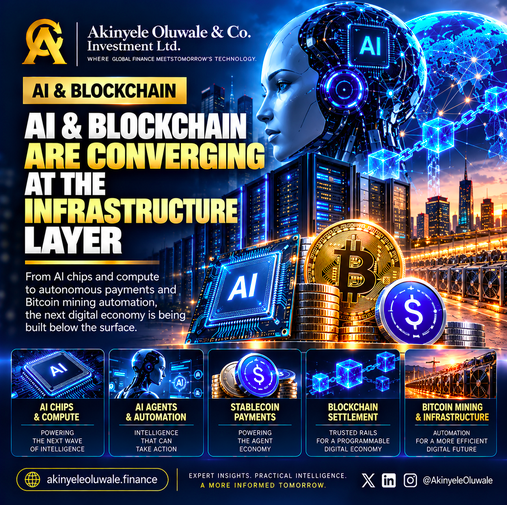
This creates a new technology stack:
The investment implications are potentially significant but investors should avoid a dangerous shortcut:
AI + blockchain does not automatically equal investment value.
The real opportunity lies in identifying where the technologies solve genuine economic problems.
Artificial intelligence is often presented as if intelligence exists in the cloud almost magically.
It does not. AI is extremely physical. Large models require enormous quantities of computing power. Computing power requires chips. Chips require semiconductor manufacturing. Servers require data centres. Data centres require electricity. Networks require connectivity and all of it requires enormous amounts of capital.
That is why the current AI investment boom has increasingly become an infrastructure story.
The Bank of Korea provided a reminder of this today. It warned that South Korea's semiconductor exports could be between $50 billion and $100 billion lower than previous forecasts next year if major U.S. technology companies reduce AI infrastructure spending.
That illustrates how economically important AI capital expenditure has become.
AI is no longer merely a software story.
It has become:
CAPITAL → CHIPS → COMPUTE → DATA CENTRES → MODELS → APPLICATIONS → PRODUCTIVITY
Blockchain introduces another potential layer. If AI agents increasingly transact autonomously, the financial infrastructure underneath those transactions must also become programmable.
This is where stablecoins and blockchain settlement become interesting.
On October 20, Tether Capital announced its participation in Tenstorrent's $1.5 billion Series E funding round. The round valued Tenstorrent at approximately $6.2 billion.
Tenstorrent is developing high-performance processors, computing systems and software designed to provide alternatives within the AI computing market. Why would a company primarily associated with stablecoins invest in AI chips?
That is precisely why the development is interesting. Tether is increasingly positioning itself beyond stablecoins.
Its activities now span:
Digital money, Bitcoin infrastructure, Energy, AI, Computing, Payments
This suggests a broader strategic view. Digital money may be one layer of the emerging digital economy. Compute may be another.
AI may provide intelligence. Blockchain may provide economic coordination.
Tether's investment in AIsa provides another piece of the puzzle.
AI agents can already perform increasingly complex tasks but many digital services remain designed around human customers.
Consider what happens when an AI agent needs:
premium data,
an API,
an AI model,
cloud computing,
or
specialist software.
Traditional systems may require someone to create an account, enter card information, choose a subscription and manually authorize access.
That creates friction.
AIsa is attempting to combine service access and payment infrastructure so agents can access AI models, data, APIs, software and compute through one interface, with businesses able to establish spending limits.
That gives us another piece of the architecture:
The payment layer becomes essential.
We should now distinguish between three different layers of the AI-blockchain opportunity.
This includes:
Chips
Servers
Data centres
Electricity
Connectivity
Without these resources, artificial intelligence cannot operate.
This is where investments such as Tenstorrent become relevant.
This includes:
Models
Agents
Data
Software
Inference
This layer determines what AI systems can actually do.
This includes:
Identity
Payments
Stablecoins
Wallets
Blockchain settlement
Tokenized assets
This layer determines whether AI systems can participate economically.
Put them together:
This is a much more useful way to understand AI and blockchain than simply asking which cryptocurrency has “AI” attached to its name.
One of the strongest areas of convergence remains payments. Circle reported earlier this year that 99.3% of x402 agent-payment volume was settling in USDC.
That figure deserves context. The AI-agent economy remains extremely young. We should not extrapolate early market share indefinitely but the development demonstrates why stablecoins are attracting attention.
AI agents potentially require payment systems capable of being:
Programmable
Always available
Internet-native
Low cost
Fast
Machine-readable
Traditional card networks and banks are also adapting to agentic commerce. So this is not necessarily a future in which blockchain replaces every existing payment system.
A more realistic outcome may involve several systems competing and connecting. The winning infrastructure will likely be determined by:
cost, trust, compliance, interoperability and reliability.
The second important development comes from Bitcoin infrastructure. On October 24, Tether announced broad industry support for its Mining Development Kit.
According to the company, 15 mining companies, ASIC manufacturers and mining pools are participating in the initiative.
The objective is to create a shared open infrastructure layer capable of improving interoperability across Bitcoin-mining hardware and software. The interesting part for today's discussion is automation.
Mining facilities increasingly resemble industrial computing operations.
They contain:
specialized processors,
power infrastructure,
cooling systems,
monitoring equipment,
networking,
and
energy-management systems.
AI can potentially help optimize some of those operations. This could include equipment monitoring, predictive maintenance, energy management and automated operational decision-making.
That creates another convergence point:
Again, the significance is not another AI token.
It is infrastructure becoming intelligent.
At Akinyele Oluwale & Co. Investment Ltd., we believe the AI-blockchain conversation needs to mature.
The first generation of the narrative was often:
“Put AI on blockchain.”
That was too simplistic.
The better question is:
Where does each technology have a genuine comparative advantage?
AI is exceptionally good at:
Pattern recognition
Prediction
Automation
Reasoning
Optimization
Decision support
Blockchain can be useful for:
Digital ownership
Programmable settlement
Transparent transaction records
Digital payments
Coordination between independent participants
Stablecoins can provide:
Digital money
Compute infrastructure provides:
Processing power
When these technologies are combined intelligently, a potentially powerful architecture emerges but forcing blockchain into an AI application where it provides no economic advantage creates complexity rather than value.
Likewise, attaching AI terminology to a cryptocurrency does not make that cryptocurrency valuable.
Our framework is therefore:
Start with the problem.
Not the token.
Today's Bank of Korea warning illustrates how important AI capital expenditure has become globally.
Watch spending by major technology companies on:
Data centres
GPUs
Networking
Energy
Cloud infrastructure
If AI infrastructure spending slows materially, the effects could spread far beyond technology stocks.
The semiconductor market is strategically important.
Watch whether companies such as Tenstorrent can develop meaningful alternatives within AI computing.
Competition could influence both the economics and accessibility of AI.
The important question is no longer whether an AI agent can make a blockchain payment.
It can.
The question is whether agent-driven transactions become economically meaningful at scale.
Watch:
active agents,
real transaction volume,
average transaction value,
merchant adoption,
and
actual economic use.
Stablecoins remain one of the strongest bridges between AI and blockchain.
But competition will intensify.
Banks, card networks and technology companies are all developing systems for autonomous commerce.
Stablecoins must prove that they offer superior economics or functionality.
An autonomous AI agent cannot simply have unlimited access to money.
Someone must establish:
what it can spend,
how much it can spend,
where it can spend,
who is responsible,
and
how authorization can be withdrawn.
Identity and permission may become as important as payments themselves.
Bitcoin mining is one example.
But AI could increasingly appear across:
network monitoring,
cybersecurity,
smart-contract analysis,
fraud detection,
risk management,
and
blockchain operations.
This may ultimately prove more economically important than many explicitly branded “AI crypto” projects.
Today's AI & Blockchain developments give us eight important lessons.
Chips, compute, data centres and electricity matter enormously.
Payments, settlement, ownership and coordination are the important layers.
The convergence is increasingly happening through infrastructure.
But they will compete with evolving traditional payment rails.
Permission, identity and accountability will be essential.
Mining increasingly combines energy, computing and intelligent operational systems.
Investors should separate narratives from economic utility.
Our emerging framework is:
Surrounding everything:
Akinyele Oluwale & Co. Investment Ltd. provides financial intelligence and investment education focused on global finance, institutional capital, markets and emerging technology.
Our approach to AI and blockchain begins with economic reality. We do not assume every AI development requires blockchain. We do not assume every blockchain application needs artificial intelligence and we do not assume every project combining the two technologies will create economic value.
Instead, we ask:
What problem is being solved?
Why is AI necessary?
Why is blockchain necessary?
Who is the customer?
Who pays?
What infrastructure is required?
Can the economics work at scale?
Those questions matter because the next phase of technological development is becoming increasingly capital intensive.
Artificial intelligence needs enormous computing infrastructure. Autonomous agents need access to digital services.
Digital services need payment systems. Blockchain networks can provide programmable settlement.
Stablecoins can provide digital money and intelligent automation can potentially improve the operation of physical infrastructure itself.
This creates a powerful circular architecture:
That is the convergence worth studying.
Not because it guarantees that every blockchain project will succeed. Not because it guarantees that every AI company will generate attractive returns and certainly not because a token carries the letters “AI.”
The significance is that several major technological and financial systems are beginning to interact.
The companies that successfully connect intelligence, computing, payments and trusted digital infrastructure could become important participants in the next digital economy.
The investment lesson is therefore straightforward:
Do not chase the label.
Study the infrastructure.
Understand the economics.
Measure real usage.
Follow the capital.
Because underneath the excitement surrounding artificial intelligence and blockchain, a much larger contest is developing.
It is the contest to build the infrastructure on which the intelligent digital economy will operate.
Observe the change. Understand the implications. Position with discipline.
Akinyele Oluwale & Co. Investment Ltd.
Where Global Finance Meets Tomorrow's Technology.
akinyeleoluwale.finance
This publication is for educational and informational purposes and does not constitute individualized investment, financial, legal or tax advice.