

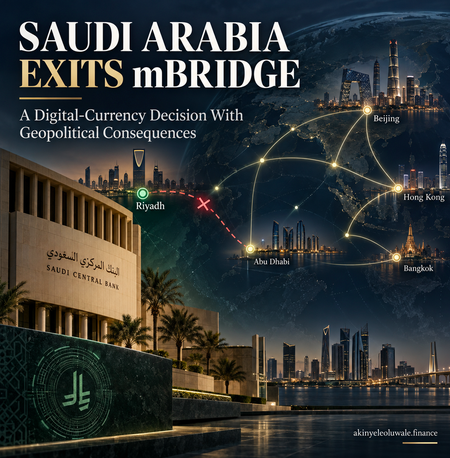
Saudi Arabia Exits mBridge: What It Means for the Future of Cross-Border Digital Money
Published: September 20, 2026
Category: Stablecoins & Payments / Central Banks
By: Akinyele Oluwale
Executive Summary
Saudi Arabia has withdrawn from mBridge, the blockchain-based cross-border settlement platform connecting participating central banks through central bank digital currencies.
The Saudi Central Bank joined mBridge as a full participant in 2024. According to its explanation, its involvement was limited and exploratory, and the withdrawal followed the completion of its planned proof-of-concept work. Therefore, the decision should not automatically be interpreted as a rejection of central bank digital currencies, blockchain technology or financial cooperation with China.
Nevertheless, Saudi Arabia’s exit carries strategic importance.
The Kingdom occupies a significant position in global energy markets, Gulf finance and the international monetary system. Its participation had strengthened the perception that mBridge could develop into a meaningful alternative settlement channel for trade between Asia and the Middle East.
Its withdrawal raises questions about the governance, geopolitical acceptability and international scalability of cross-border central bank digital currency infrastructure.
The central issue is no longer whether blockchain technology can make international payments faster. The technology has already demonstrated that possibility. The harder questions are who controls the infrastructure, which currencies dominate it, how participating countries manage sanctions exposure, and whether rival geopolitical blocs will accept the same digital settlement rails.
Saudi Arabia’s decision illustrates that the future of digital money will be determined by diplomacy and monetary power as much as by technological efficiency.
Background
Project mBridge began as a collaborative experiment involving the Bank for International Settlements Innovation Hub, the Hong Kong Monetary Authority, the Bank of Thailand, the Central Bank of the United Arab Emirates and the Digital Currency Institute of the People’s Bank of China.
The project was designed to address persistent weaknesses in international payments. Traditional cross-border transfers frequently involve several correspondent banks, repeated compliance checks, currency conversions, different operating hours and delayed settlement.
These layers can make transactions slow, expensive and difficult to track.
mBridge proposed a different model: participating central and commercial banks would conduct cross-border payments and foreign-exchange transactions directly through a shared distributed-ledger platform. Digital representations of sovereign currencies could be transferred and settled almost immediately.
A 2022 pilot involving 20 commercial banks processed more than 160 payment and foreign-exchange transactions with a combined value exceeding $22 million. The platform subsequently reached its minimum viable product stage in 2024.
Saudi Arabia joined as a full participant that year, while more than 26 central banks and institutions participated as observers. Its inclusion appeared to deepen the platform’s connection with the Gulf and potentially with international energy trade.
The Bank for International Settlements later stepped away from its direct operational involvement. Governance of the project moved towards the participating central banks, increasing the perception that China would exercise considerable influence over its future development.
Saudi Arabia has now ended its formal participation after completing what it described as its intended proof-of-concept programme.
Why it matters
Saudi Arabia’s departure matters because cross-border payment infrastructure is not politically neutral.
A payment system determines how transactions are routed, which institutions can participate, what information becomes visible, whose regulations apply and whether payments can be delayed, rejected or sanctioned.
The current international system remains heavily connected to the US dollar, correspondent banking relationships and messaging infrastructure such as SWIFT. This gives the United States and its allies substantial influence over the movement of global capital.
mBridge offers a model in which participating central banks can settle transactions directly using sovereign digital currencies. In theory, this could reduce costs and accelerate settlement. It could also reduce dependence on dollar-based intermediaries.
That second possibility makes the project geopolitically sensitive.
Saudi Arabia maintains important economic and energy relationships with China, while its currency remains pegged to the US dollar and its financial and security relationships with the United States remain significant. Participation in a payment network perceived as an alternative to the dollar system therefore requires careful diplomatic balancing.
The Saudi withdrawal does not prove that external political pressure caused the decision. The Saudi Central Bank described its participation as a limited experiment that concluded according to plan. However, the broader geopolitical environment cannot be ignored when assessing the strategic implications.
The decision also demonstrates that successful technology does not automatically produce international adoption. Cross-border digital currency systems require trust in governance, legal certainty, common compliance standards, cybersecurity coordination and agreement about how power is distributed among participating countries.
Stakeholders: Winners and Losers
The traditional dollar-centred financial system is a potential beneficiary. Saudi Arabia’s withdrawal removes, at least formally, an influential Gulf participant from a platform often discussed as an alternative to conventional correspondent banking.
Existing international banks may also benefit in the short term. Their role as intermediaries remains secure when governments hesitate to transfer settlement activity to shared central-bank digital currency networks.
Competing payment projects could gain an opportunity. Saudi Arabia may continue exploring other models, including bilateral digital-currency arrangements, tokenised deposits, regulated stablecoins or improvements to conventional instant-payment systems.
China and the remaining mBridge participants face a reputational setback, but not necessarily a technological failure. The platform continues to include important financial centres and central banks. Macau’s participation and continuing activity among existing members demonstrate that the project remains operational.
The most significant losers may be businesses and individuals that continue to bear the cost of inefficient cross-border payments. A fragmented international system means companies may still face high transfer fees, delayed settlement and limited transparency.
Emerging economies could also lose if geopolitical competition prevents the development of interoperable payment infrastructure. Many developing countries would benefit from cheaper remittances and reduced dependence on lengthy correspondent-banking chains.
Short-Term Impact
In the short term, Saudi Arabia’s exit is unlikely to stop mBridge or produce an immediate disruption to international payments.
The project can continue with its remaining participants, including China, Hong Kong, Thailand and the United Arab Emirates. Other central banks may continue observing or testing the technology without committing to full membership.
However, the withdrawal may make prospective members more cautious. Central banks considering participation will examine the reasons for Saudi Arabia’s departure, the platform’s governance structure and the geopolitical consequences of joining.
The decision could also encourage mBridge’s existing members to communicate more clearly about its governance. If the platform wants broad international acceptance, it must demonstrate that no single participant can dominate its technology, transaction rules or data.
Markets should avoid exaggerated conclusions. This is not evidence that CBDCs have failed, nor does it mean that Saudi Arabia has abandoned financial innovation. It is a reminder that pilot participation does not guarantee permanent adoption.
Long-Term Impact
The long-term risk is the fragmentation of the digital monetary system.
Instead of one interoperable global infrastructure, the world could develop competing payment networks aligned with different economic and political blocs. One network could be centred on the dollar, another on the renminbi, while regional arrangements emerge across the Gulf, Europe, Africa and Latin America.
Such competition may encourage innovation, but it could also create new inefficiencies. Banks and corporations may need to maintain access to several networks, comply with different technical standards and manage conflicting regulatory requirements.
There is also a question about the future role of stablecoins.
If governments cannot agree on shared CBDC infrastructure, regulated private stablecoins and tokenised commercial-bank deposits may become more important in cross-border settlement. These instruments may be easier to scale commercially, although they introduce their own questions concerning reserves, redemption, supervision and monetary sovereignty.
For Africa, the development deserves attention. African economies face some of the world’s highest remittance and cross-border payment costs. A credible multi-currency settlement platform could improve intra-African trade and reduce transaction delays.
However, African central banks must avoid becoming passive users of infrastructure governed elsewhere. Participation should be based on transparent governance, data protection, currency sovereignty and interoperability with domestic payment systems.
The lesson from Saudi Arabia is that countries should experiment—but they must understand the strategic consequences before committing national financial infrastructure to an international network.
Editorial Perspective
Saudi Arabia’s exit should be interpreted carefully.
The available evidence supports the Saudi Central Bank’s position that the exercise was exploratory and concluded after its proof-of-concept objectives were achieved. It would be irresponsible to present the decision as definitive evidence of a diplomatic break with China or direct intervention by the United States.
Yet it would be equally mistaken to treat the departure as an ordinary technical adjustment.
Money is an instrument of economic power. The infrastructure through which money moves is also an instrument of power.
The country or coalition that establishes the dominant standards for digital settlement could influence international trade, financial data, sanctions enforcement and currency usage for decades.
mBridge demonstrated that direct, real-time settlement between central banks is technologically possible. Its next challenge is political legitimacy. A platform cannot become genuinely international if prospective members believe its governance is concentrated or its participation may damage other strategic relationships.
The future of cross-border digital finance will therefore require more than faster blockchain networks. It will require governance structures that countries consider fair, neutral and resilient.
Saudi Arabia’s decision is not the end of mBridge. It is a warning that the global transition to digital money will not follow a purely technological path.
What to Watch Next
The first issue to monitor is whether the Saudi Central Bank announces another cross-border digital-currency, tokenisation or payment-modernisation initiative.
A move towards a bilateral arrangement, Gulf-led platform or regulated private-sector settlement system would show that Saudi Arabia’s withdrawal relates to platform design rather than opposition to digital money itself.
The second issue is mBridge governance. Existing participants may introduce clearer decision-making rules, expanded membership arrangements or safeguards designed to reassure prospective central banks.
Third, investors and policymakers should watch the involvement of the United Arab Emirates. The UAE remains both an important mBridge participant and a major financial centre with relationships across Western and Asian markets.
Fourth, the role of the digital yuan deserves attention. If the renminbi continues to dominate settlement activity on the platform, concerns that mBridge primarily advances China’s international monetary strategy may intensify.
Fifth, monitor the response of the United States, international financial institutions and global commercial banks. Efforts to modernise conventional cross-border payments may accelerate if alternative digital settlement platforms continue expanding.
Finally, African policymakers should monitor these developments from the perspective of infrastructure ownership, remittance costs and monetary sovereignty. The continent should participate in international digital-payment innovation, but it must also help shape the standards under which that infrastructure operates.
Notes
Saudi Arabia’s withdrawal from mBridge was reported by the [Financial Times](https://www.ft.com/content/ac104987-f43d-4e7d-97b6-057d98f7e422). The Saudi Central Bank reportedly stated that its participation was limited, exploratory and completed according to its original proof-of-concept plan.
The [Bank for International Settlements](https://www.bis.org/media-releases/20240605-project-mbridge-reaches-minimum-viable-product-stage-and-invites-further-international) confirmed Saudi Arabia’s admission as a full participant in 2024 and described mBridge as a distributed-ledger platform designed to facilitate immediate cross-border payments and settlement.
The BIS’s [2022 project report](https://www.bis.org/publications/project-mbridge-connecting-economies-through-cbdc) documented more than 160 real-value transactions involving 20 commercial banks, with combined payment and foreign-exchange transaction value exceeding $22 million.
This publication is for information and education. It does not constitute financial, legal or investment advice.
Akinyele Oluwale & Co. Investment Ltd.
Where Global Finance Meets Tomorrow’s Technology.