

Published: October 21, 2026
Category: Blockchain & Technology
By: Akinyele Oluwale
The AI economy will ultimately run on infrastructure before it runs on intelligence.
A major change is taking place in how economic infrastructure is defined.
For decades, development infrastructure largely meant:
Roads. Ports. Electricity. Water. Railways.
Those remain essential.
But the modern economy increasingly requires another layer:
On October 20, the World Bank Group launched its first Digital Strategy, combining its public- and private-sector capabilities around four priorities:
1. Expand reliable connectivity
2. Make devices and data more affordable
3. Expand digital services and skills
4. Build readiness for artificial intelligence
The strategy comes with a stark digital divide: the World Bank says more than 2 billion people were offline globally in 2025, while internet usage stood at only 23% in low-income countries compared with 94% in high-income countries. World Bank
That gap matters because the next phase of economic competition will not be determined simply by who can access AI.
It will increasingly be determined by who possesses the infrastructure required to use AI productively at scale.
Yesterday, our Day 43 intelligence framework was:
Electricity → Connectivity → Skills → AI Adoption → Productivity → Jobs → Growth
Today, the World Bank's new strategy provides an institutional roadmap for building those foundations.
Consider the sequence.
Without reliable electricity, digital infrastructure struggles.
Without connectivity, cloud services and AI cannot reach businesses and households efficiently.
Without affordable devices and data, connectivity exists without widespread participation.
Without digital skills, technology remains underutilised.
Without usable local data and computing capacity, AI adoption becomes constrained.
And without productive adoption, technology may fail to translate into meaningful economic growth.
The infrastructure question is therefore becoming much broader.
The World Bank Group launched its first comprehensive Digital Strategy on October 20.
It identifies four areas for action. World Bank
The Bank plans to support infrastructure ranging from international cables and national networks to connections serving businesses, homes, schools and clinics.
Significantly, it says electricity and connectivity should be planned together where both are missing.
Having network coverage does not necessarily mean people can participate in the digital economy.
Smartphones and data must also be affordable.
The strategy covers digital identification, payments and secure information-sharing alongside digital literacy and employment-related training.
Countries need:
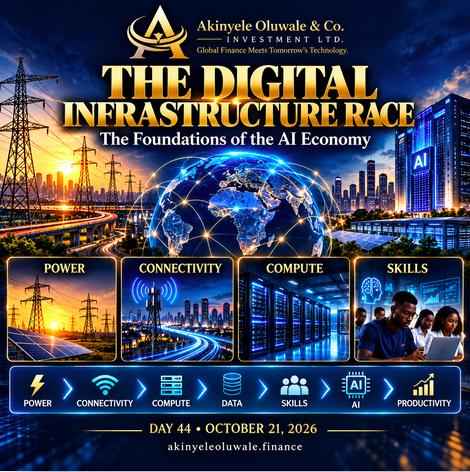
Connectivity
Compute
Usable local data
Skills
before they can capture AI's broader economic potential.
This is why the AI race increasingly begins far below the AI model itself.
The World Bank also announced something especially important:
The initiative aims to give emerging-market governments access to more affordable computing capacity through shared, pay-as-you-go GPU infrastructure, rather than requiring every country to construct standalone national data centres.
Its initial focus will be:
with Cassava Technologies and NVIDIA named as knowledge partners. World Bank
This deserves attention.
One of the biggest barriers to participating in the AI economy is the enormous capital requirement associated with advanced computing infrastructure.
A shared model potentially changes the economics from:
Own everything
toward:
That resembles transformations already seen elsewhere in technology.
Companies once needed their own servers.
Cloud computing enabled infrastructure to be consumed as a service.
A similar model could potentially broaden access to AI computing capacity.
But infrastructure alone remains insufficient.
The objective must ultimately be productive application.
For investors and institutions, this creates a broader way of thinking about the AI economy.
Instead of asking only:
consider the infrastructure surrounding AI.
The ecosystem includes:
Power generation
Transmission infrastructure
Data centres
Semiconductors
Cloud computing
Fibre networks
Telecommunications
Cooling systems
Cybersecurity
Data infrastructure
Digital payments
Digital identity
Workforce skills
The investment logic is straightforward:
And bottlenecks create demand for infrastructure.
This does not mean every company exposed to AI infrastructure will automatically succeed.
Valuation, competition, financing costs and execution still matter.
But it means the economic footprint of AI extends considerably beyond AI software companies.
The world's AI debate has become fascinated with intelligence.
Which model is smartest?
Which company has the most powerful chips?
Who has the biggest data centre?
Who reaches artificial general intelligence first?
Those questions matter.
But for much of the global economy, a more immediate question exists:
A farmer without connectivity gains little from an AI agricultural application.
A small business without reliable electricity cannot depend on digital infrastructure.
A student without affordable data cannot fully participate in digital education.
A country without adequate computing capacity may become primarily a consumer of AI developed elsewhere.
This is why infrastructure deserves to move toward the centre of the AI debate.
World Bank President Ajay Banga recently made the distinction particularly clear: frontier “Big AI” requires computing power, energy, data and specialist skills that put it beyond the immediate reach of many developing economies, while practical “small AI” can already support farmers, teachers, health workers and entrepreneurs. World Bank
The AI economy will ultimately run on infrastructure before it runs on intelligence.
And our second principle:
Technology creates possibility. Infrastructure determines whether that possibility can scale.
This combination deserves particular attention.
The World Bank explicitly says the two should be planned together where both are missing. World Bank
Watch whether shared GPU capacity becomes economically viable for emerging economies.
If successful, it could reduce the requirement for each country to finance expensive standalone infrastructure.
Digital identification, payments and secure data exchange can increasingly become foundational economic systems rather than merely government IT projects. World Bank
Practical AI designed around local problems, languages and infrastructure limitations could become particularly important across agriculture, healthcare, education and small businesses. World Bank Live
Greater digitalisation creates greater dependence on digital infrastructure.
Security therefore needs to scale alongside adoption.
The new AI Infrastructure and Readiness Initiative's initial Africa focus makes this particularly relevant.
The question is not whether Africa will participate in AI.
The more important question is:
How much of the infrastructure, capability and economic value surrounding AI can African economies build and retain?
1. The World Bank Group has launched its first Digital Strategy. World Bank
2. Its four priorities are connectivity, affordability, digital services and skills, and AI readiness.
3. More than 2 billion people remained offline globally in 2025.
4. Internet usage was only 23% in low-income countries versus 94% in high-income countries.
5. The World Bank is also launching shared pay-as-you-go AI computing infrastructure, initially focused on Africa and Latin America. World Bank
6. AI infrastructure extends beyond chips and data centres to electricity, connectivity, data, cybersecurity and skills.
7. The next technological divide could increasingly be an infrastructure divide.
And the economic chain:
Akinyele Oluwale & Co. Investment Ltd. provides institutional financial intelligence at the intersection of global finance, technology and macroeconomics.
Our coverage includes artificial intelligence, blockchain technology, crypto and digital assets, institutional finance, stablecoins and payments, tokenization and real-world assets, central banks, and macroeconomic developments.
Our objective is to move beyond headlines and examine:
What changed?
Why does it matter?
Where is capital moving?
Which infrastructure enables the next economic transition?
What should investors, institutions and decision-makers watch next?
Observe the change.
Understand the implications.
Position with discipline.
Akinyele Oluwale & Co. Investment Ltd.
Where Global Finance Meets Tomorrow's Technology.