

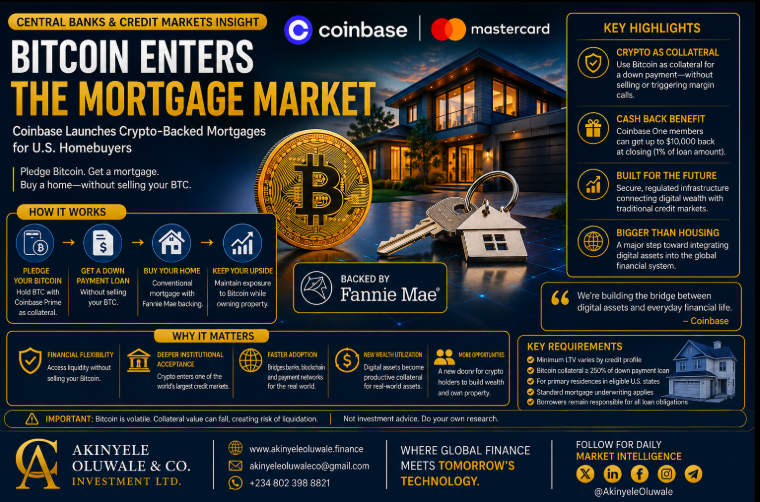
Bitcoin Enters the Mortgage Market: Coinbase Turns Digital Wealth Into Home-Buying Collateral
U.S. homebuyers can now pledge Bitcoin toward a mortgage down payment without selling it. The development is bigger than housing: it shows digital assets beginning to interact directly with one of the most important credit markets in the world. But turning volatile assets into collateral also introduces risks investors should understand.
Published: 26 August 2026
Category: Central Banks • Credit Markets • Bitcoin • Digital Finance
By: Akinyele Oluwale & Co. Investment Ltd.
Executive Summary
Bitcoin is moving another step closer to conventional finance.
Coinbase is promoting crypto-backed mortgages that allow eligible U.S. borrowers to pledge Bitcoin as collateral to finance their cash down payment without selling their BTC.
The mortgage product is originated and serviced by Better, while Coinbase provides the crypto infrastructure. The home loan itself is structured as a conventional conforming mortgage with Fannie Mae backing. (Coinbase)
For Coinbase One members who qualify, Better is also offering closing-cost credits equal to 1% of the mortgage value, capped at $10,000.
This is not merely another crypto product.
Bitcoin is increasingly being treated as collateral within traditional credit markets.
What Happened?
The structure is important.
Rather than selling Bitcoin to generate a down payment, an eligible borrower pledges BTC and receives a separate crypto-collateralized down-payment loan alongside the conventional mortgage.
Coinbase says Bitcoin collateral must initially equal at least 250% of the down-payment loan. That means a $100,000 down-payment loan would require approximately $250,000 worth of BTC collateral.
The pledged Bitcoin is held by Better through Coinbase Prime until the underlying obligation is repaid or refinanced.
Importantly, this mortgage structure is designed without the conventional day-to-day margin calls associated with many crypto loans. (Decrypt)
Background
Historically, crypto holders wanting to buy property faced a simple problem:
Sell Bitcoin → Generate Cash → Pay Down Payment
That could mean surrendering future exposure to Bitcoin and potentially creating tax consequences.
Collateralized lending changes the equation:
Hold Bitcoin → Pledge Bitcoin → Borrow Against It → Purchase Property
This is a familiar concept in traditional wealth management.
Affluent investors have long borrowed against securities rather than selling them.
What is changing is the collateral.
Digital assets are beginning to enter financial structures previously dominated by stocks, bonds and property.
Why It Matters
Housing sits at the heart of the U.S. credit system.
Once Bitcoin can interact with mortgages, digital wealth becomes increasingly connected with traditional household balance sheets.
That represents another stage in institutionalization:
Bitcoin → Investment Asset → Treasury Asset → Collateral → Credit Infrastructure
The development also matters for monetary transmission.
Central-bank interest rates influence mortgage pricing and housing affordability. If crypto becomes another recognized source of collateral, the relationship between digital wealth, household borrowing and conventional credit markets becomes deeper.
Winners & Losers / Key Stakeholders
Long-term Bitcoin holders may gain greater financial flexibility because they can potentially access liquidity without immediately disposing of their holdings.
Mortgage lenders and crypto custodians gain access to a new category of borrower.
Coinbase benefits strategically because Bitcoin becomes useful beyond trading.
But borrowers take on a significant trade-off:
They are combining housing debt with exposure to a volatile asset.
Keeping the Bitcoin preserves upside but it also preserves downside risk.
Short-Term Impact
This won't suddenly transform the American mortgage market.
Eligibility, credit underwriting and substantial collateral requirements limit the immediate addressable market.
But the precedent matters.
The first Fannie Mae-backed Bitcoin-collateralized mortgage was reported as completed earlier this year, demonstrating that the concept has moved beyond a proposal. (The Block)
The next test is scale.
Long-Term Impact
The bigger story could be the emergence of a digital collateral economy.
Bitcoin and other qualifying digital assets could increasingly support borrowing for property, businesses and institutional financing.
That would make crypto wealth more economically productive but it could also create new connections between volatile digital markets and traditional credit.
Those connections deserve careful risk management.
Editorial Perspective
Bitcoin advocates have spent years arguing that BTC should be viewed as capital rather than merely something to trade.
Mortgages provide a practical test of that thesis.
An asset becomes considerably more economically important when owners don't have to sell it every time they need liquidity.
But investors should remember:
Collateralized wealth is still leveraged wealth.
Financial innovation doesn't eliminate risk. It redistributes it.
What to Watch Next
Watch actual mortgage originations, borrower demand, collateral requirements, regulatory responses and whether additional lenders enter the market.
Most importantly, watch whether Bitcoin-backed credit expands without generating excessive leverage.
Investing Lesson
Owning an appreciating asset and borrowing against it are two different investment decisions.
Never evaluate the upside of retaining the asset without also evaluating the liability created against it.
Key Takeaways
The evolution continues:
Bitcoin as Savings → Bitcoin as Investment → Bitcoin as Collateral → Bitcoin-Backed Credit
That is a meaningful expansion of Bitcoin's financial utility.
Editorial Bottom Line
The important development isn't that Americans can suddenly “buy houses with Bitcoin.”
They aren't.
The deeper shift is that Bitcoin can increasingly sit on one side of a conventional credit transaction as collateral while dollars finance the real-world purchase.
That is how digital assets move from investment portfolios into the plumbing of traditional finance.
Akinyele Oluwale & Co. Investment Ltd.
Where Global Finance Meets Tomorrow’s Technology