

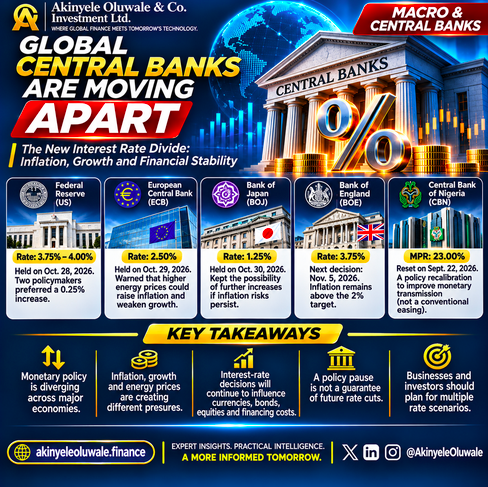
The Federal Reserve, European Central Bank, Bank of England and emerging-market monetary authorities face different economic pressures. For investors and businesses, the critical issue is no longer simply when interest rates will fall, but whether inflation, growth and financial conditions will allow central banks to move in the same direction.
Published: Wednesday, November 4, 2026
Category: Macro & Central Banks
By: Akinyele Oluwale & Co. Investment Ltd.
Global monetary policy is entering a period in which investors can no longer assume that major central banks will respond to economic conditions in the same way.
Inflation pressures differ across countries. Economic growth is uneven. Government borrowing requirements remain significant, and financial markets are sensitive to changes in interest-rate expectations. The result is a more complicated environment for currencies, bonds, equities, commodities and digital assets.
The central question for November is whether policymakers can maintain price stability without unnecessarily weakening economic activity or allowing financial vulnerabilities to build.
For Nigerian businesses and investors, these developments matter because global interest rates influence international capital flows, exchange-rate conditions, imported costs and the price of financing.
Verified as of November 4, 2026. Policy rates are not directly comparable across countries because their monetary frameworks differ.
Central bank | Latest policy rate | Latest position |
|---|---|---|
US Federal Reserve | 3.75%–4.00% | Held October 28 |
European Central Bank | 2.50% deposit rate | Held October 29 |
Bank of Japan | 1.25% | Held October 30 |
Bank of England | 3.75% | Held September 17; next decision November 5 |
Central Bank of Nigeria | 23.00% MPR | Reset September 22 |
The Federal Reserve's October decision was notable because two policymakers voted for a rate increase. The ECB warned that higher energy prices could simultaneously increase inflation and weaken growth. Japan's central bank also signalled the possibility of further tightening.
In Nigeria, the CBN's September move from 26.5% to 23% requires particular care in interpretation. The central bank characterised it as a recalibration of its policy framework, rather than a straightforward 350-basis-point easing of underlying monetary conditions.
Global central banks are confronting a difficult monetary-policy environment as November 2026 begins. The challenge is no longer simply whether inflation is rising or falling. Policymakers must determine whether inflationary pressures are temporary, whether they are spreading through the economy, and how much additional financial tightening businesses and households can withstand.
The latest decisions reveal important differences.
On October 28, the United States Federal Reserve maintained its benchmark interest-rate range at 3.75%–4.00%. The decision was approved by a 10–2 vote, with two policymakers preferring an immediate increase.
On October 29, the European Central Bank kept its deposit facility rate at 2.50%. However, it warned that rising energy prices could push inflation higher while weakening economic growth.
On October 30, the Bank of Japan maintained its policy rate at 1.25%, while indicating that further increases may be necessary if inflation risks persist. In the United Kingdom, the Bank of England's next monetary-policy decision is scheduled for November 5. Its existing Bank Rate stands at 3.75%, with inflation remaining above its 2% target.
Nigeria presents a different monetary-policy picture.
At its September meeting, the Central Bank of Nigeria reset its Monetary Policy Rate from 26.5% to 23%. Importantly, the CBN explained that the adjustment was intended to improve the transmission of monetary policy rather than represent a conventional easing of its underlying stance.
These developments illustrate a central reality: the world's major economies are facing different combinations of inflation, growth, currency and financial-stability pressures.
For investors, the implications extend beyond interest rates.
They influence bond yields, exchange rates, equity valuations, corporate borrowing costs, capital flows and the pricing of risk across global financial markets.
Our central assessment is that monetary-policy divergence is becoming a defining feature of the investment environment. Businesses and investors must prepare for different interest-rate paths rather than assume that global borrowing costs will move together.
Interest rates are among the most influential prices in an economy. They affect how much businesses pay to borrow money, how households finance consumption and how investors value financial assets. Consider a manufacturing company planning a ₦500 million expansion. If the company borrows at 25% annually, its annual interest expense would be ₦125 million, assuming the entire principal remains outstanding for the year and ignoring fees.
At 20%, the equivalent annual interest expense would be ₦100 million. That difference of ₦25 million could materially affect the project's profitability.
However, the benchmark interest rate announced by a central bank is not necessarily the rate a business pays its lender.
Commercial lending rates also reflect credit risk, funding costs, loan tenor, collateral and banking-sector conditions.
The same principle applies internationally.
When central banks maintain relatively high rates, financing can remain expensive even when financial markets expect future reductions.
When inflation is elevated, lowering interest rates too quickly can also create risks. It may stimulate spending before the underlying causes of inflation have been resolved. Central banks therefore face a difficult balancing act. They must protect price stability without creating unnecessary economic weakness.
This challenge becomes particularly complicated when inflation is driven by supply disruptions, including rising energy prices.
Higher interest rates cannot directly produce more crude oil or eliminate geopolitical disruptions. They can, however, influence demand, inflation expectations and financing conditions.
That is why the latest central-bank decisions deserve close examination.
On October 28, 2026, the Federal Open Market Committee maintained its target range for the federal funds rate at 3.75%–4.00%. The decision was approved by a 10–2 vote.
Two members, Lisa D. Cook and Beth M. Hammack, preferred increasing the target range by 25 basis points.
This disagreement is important. It suggests that some policymakers remain concerned that the existing policy stance may not be sufficiently restrictive to return inflation sustainably to the Federal Reserve's 2% objective.
The Fed described economic activity as expanding at a strong pace, supported by resilient domestic spending, productivity growth and robust capital investment. It also acknowledged that inflation remained elevated. For investors, the message is that a decision to hold rates should not automatically be interpreted as preparation for an imminent cut.
A central bank may hold rates because it believes the current policy stance is appropriate. It may also hold rates while considering whether additional tightening could become necessary.
The lesson: A pause in interest-rate changes is not necessarily a signal that monetary tightening has ended.
On October 29, the European Central Bank maintained its three key interest rates. The deposit facility rate remained at 2.50%, the main refinancing operations rate at 2.65%, and the marginal lending facility rate at 2.90%.
The ECB's explanation was particularly significant.
It warned that higher energy prices were creating upside risks to inflation and downside risks to economic growth.
This is one of the most difficult situations for a central bank.
Ordinarily, weaker economic growth might support lower interest rates but when inflation is simultaneously rising, reducing rates may risk reinforcing price pressures.
Economists often describe this combination of weak growth and elevated inflation as a stagflationary environment. It is important, however, not to conclude that the entire euro area has entered a prolonged period of stagflation merely because these risks have increased.
The ECB indicated that it would continue making decisions based on incoming economic and financial data. It also avoided committing to a predetermined interest-rate path.
The lesson: Energy-driven inflation can make monetary-policy decisions more difficult because measures aimed at reducing inflation may also restrain economic activity.
On October 30, the Bank of Japan maintained its short-term policy rate at 1.25%.
The decision was approved by an 8–1 vote. One policymaker preferred raising the rate to 1.50%. The central bank also raised its inflation forecast and maintained the possibility of further interest-rate increases.
Japan's monetary-policy position is important for international financial markets because the country has historically been associated with relatively low interest rates.
Changes in Japanese rates can influence global investment strategies involving borrowing, currencies and international asset allocation. For example, investors sometimes borrow in a relatively low-interest-rate currency to finance investments in assets offering higher expected returns. Such strategies can become vulnerable when borrowing costs rise or exchange rates move unfavourably.
Therefore, changes in Japanese monetary policy may have implications beyond Japan's domestic economy. However, the magnitude of any global market effect depends on investor positioning, currency movements and broader financial conditions.
The lesson: Japan's monetary-policy direction deserves attention because changes in domestic interest rates can influence international capital flows.
The Bank of England's next Monetary Policy Committee announcement is scheduled for November 5, 2026.
As of November 4, its Bank Rate remains at 3.75%. At the September meeting, the committee voted 6–3 to maintain the rate, with three members preferring an increase to 4%.
UK inflation remains above the central bank's 2% target.
The Bank has also identified energy-price developments as an important source of inflation risk.
This creates a difficult policy environment.
Maintaining interest rates may help contain inflation expectations, but prolonged restrictive financial conditions can weaken borrowing, investment and household spending.
Reducing rates too early could create the opposite problem if inflation remains persistent.
The November decision should therefore be assessed alongside the Bank's updated inflation and growth projections. As of this article's publication date, the November 5 decision has not yet been announced.
The lesson: Investors should distinguish between expectations of a policy decision and an actual decision formally communicated by the central bank.
At its September 21–22 meeting, the Central Bank of Nigeria reset the Monetary Policy Rate to 23%.
The previous rate was 26.5%.
At first glance, this appears to represent a reduction of 350 basis points.
However, the CBN explained that the change was part of an operational recalibration designed to improve monetary-policy transmission.
The adjustment also changed the Standing Facilities Corridor to 50 basis points above and 300 basis points below the MPR.
The central bank retained the Cash Reserve Requirement at 45% for deposit money banks and 16% for merchant banks.
Why does this matter?
The Monetary Policy Rate is intended to communicate the central bank's policy stance and influence conditions in the financial system.
However, the effectiveness of that signal depends on how market interest rates respond. If the benchmark rate becomes disconnected from prevailing money-market conditions, its usefulness as a policy signal may weaken. The CBN's September recalibration was intended to address that issue.
It would therefore be misleading to describe the move simply as a conventional monetary easing of 350 basis points without explaining the central bank's stated rationale.
For Nigerian businesses, the practical issue is whether the adjustment eventually influences actual financing costs, liquidity and credit availability.
The lesson: A change in a policy benchmark must be interpreted within the wider monetary-policy framework.
The latest decisions demonstrate why central banks are not following a single global monetary-policy path. The United States is experiencing relatively resilient economic activity alongside persistent inflation concerns. The euro area faces an energy-price shock that threatens both inflation and growth.
Japan is managing inflation risks within a different interest-rate and economic structure.
The United Kingdom is confronting above-target inflation ahead of another important policy decision. Nigeria is attempting to strengthen monetary-policy transmission while maintaining price stability. These differences matter because global financial markets are interconnected.
Capital can move across borders. Currency values respond to relative interest rates and expectations. Government bond yields influence financing conditions. Commodity prices can affect inflation in multiple countries simultaneously. However, interconnected markets do not mean identical economic outcomes.
A rise in oil prices may benefit some energy-exporting businesses while increasing costs for energy-importing economies.
Similarly, higher interest rates may attract certain international capital flows while making domestic borrowing more expensive.
For Nigeria, higher global energy prices can create both opportunities and pressures.
Oil-related government revenue may benefit under some conditions but fuel costs, transportation expenses, imported inflation and exchange-rate pressures may also increase. The net economic effect depends on production volumes, domestic energy arrangements, fiscal policy and external financial conditions.
This is why macroeconomic analysis must consider more than one indicator.
Bond prices and market yields generally move in opposite directions.
When required market yields rise, the prices of existing fixed-rate bonds tend to fall.
For example, a bond paying a fixed coupon becomes less attractive when newly issued comparable bonds offer higher yields.
The magnitude of the price movement depends on factors including the bond's duration and credit risk.
Higher interest rates can affect equity valuations by increasing the discount rates applied to expected future cash flows.
However, the effect differs across industries and companies.
Businesses with strong earnings and limited debt may be less sensitive than highly leveraged companies.
Differences in interest rates can influence currency demand and international capital flows.
Nevertheless, exchange rates are also affected by inflation, trade balances, political developments and investor confidence.
A currency with a higher interest rate does not necessarily appreciate.
Digital assets can respond to changes in liquidity, investor risk appetite and monetary-policy expectations.
However, cryptocurrency prices are also influenced by market structure, regulation, security incidents and asset-specific developments.
There is no reliable rule that every interest-rate reduction automatically produces a cryptocurrency rally.
Financing costs remain a critical consideration for companies planning capital investment.
Businesses should assess their capacity to service debt under different borrowing-cost and revenue scenarios.
Changes in monetary policy influence funding costs, loan pricing, investment portfolios and credit demand.
The effects on profitability depend on each institution's balance-sheet structure and risk exposure.
At Akinyele Oluwale & Co. Investment Ltd., we believe one of the most important lessons from the latest monetary-policy decisions is that global financial conditions are becoming more difficult to interpret through a single narrative.
Investors often seek simple explanations.
They may assume that inflation is falling everywhere, that interest rates will decline together or that lower rates will automatically support all financial assets.
The evidence does not support such broad assumptions.
The Federal Reserve has maintained rates while two policymakers preferred further tightening.
The ECB is balancing inflationary energy pressures against weaker growth prospects.
Japan continues to consider additional rate increases.
The Bank of England faces another decision amid persistent inflation concerns.
Nigeria has recalibrated its monetary-policy framework rather than simply announcing conventional easing.
These developments require a more disciplined analytical approach.
For corporate executives, financial planning should incorporate alternative interest-rate and exchange-rate assumptions.
For investors, asset valuations should reflect the possibility that borrowing costs remain elevated or move differently across markets.
For policymakers, credibility depends on clear communication and the consistent application of monetary-policy objectives.
A central bank cannot control every external economic shock but it can influence expectations, financial conditions and confidence in the monetary system.
Our editorial position is that successful financial decision-making in this environment requires scenario analysis, liquidity discipline and a clear understanding of monetary-policy transmission.
The objective should not be to predict every central-bank announcement correctly.
It should be to understand how different outcomes may affect financial decisions.
Several developments deserve close attention.
1. Bank of England — November 5 decision
Monitor the Bank Rate announcement, voting pattern and updated inflation and growth projections.
2. Federal Reserve inflation data
Watch whether incoming economic information supports the existing policy stance or increases pressure for further tightening.
3. ECB energy-price assessment
Follow whether higher energy costs begin influencing wages, inflation expectations and underlying inflation.
4. Bank of Japan policy guidance
Monitor future signals concerning interest rates, inflation and currency-related financial conditions.
5. Central Bank of Nigeria
Assess whether the recalibrated MPR improves the relationship between the policy benchmark and prevailing money-market rates.
6. Government bond yields
Changes in bond yields can reveal how investors are reassessing inflation, fiscal conditions and future monetary policy.
7. Currency movements
Watch exchange-rate developments and their implications for imported costs and international financial flows.
8. Corporate financing conditions
Businesses should monitor actual lending rates rather than relying exclusively on central-bank benchmarks.
The Federal Reserve maintained its benchmark interest-rate range at 3.75%–4.00% on October 28, 2026.
Two Federal Reserve policymakers preferred an immediate 25-basis-point increase.
The European Central Bank held its deposit facility rate at 2.50% on October 29.
The ECB warned that higher energy prices could increase inflation while weakening economic growth.
The Bank of Japan maintained its policy rate at 1.25% on October 30, while keeping further tightening possible.
The Bank of England's next monetary-policy decision is scheduled for November 5.
Nigeria's central bank reset its MPR to 23% in September as part of an operational recalibration.
Monetary-policy divergence can influence currencies, bonds, equities, financing costs and international capital flows.
Central-bank policy rates should not be confused with commercial lending rates or directly compared without considering their different frameworks.
Businesses and investors should prepare for multiple monetary-policy scenarios rather than relying on a single forecast.
Akinyele Oluwale & Co. Investment Ltd. is an institutional financial intelligence platform focused on global macroeconomics, central banking, institutional cryptocurrency, artificial intelligence, blockchain, stablecoins, tokenization and financial markets.
Our mission is to explain important economic and financial developments through evidence-based analysis, practical education and an institutional investment perspective.
We aim to help business leaders, investors and financial professionals understand how global developments influence financial decisions.
The latest central-bank decisions reveal a world in which monetary policy is becoming increasingly differentiated.
The United States is balancing economic resilience against persistent inflation.
Europe is confronting the difficult consequences of higher energy prices.
Japan is maintaining the possibility of further tightening.
The United Kingdom faces an important policy decision.
Nigeria is working to strengthen the effectiveness of its monetary-policy framework.
For investors and businesses, the lesson is clear.
Do not build financial decisions around the assumption that interest rates will fall everywhere at the same time.
Do not interpret a central-bank pause as a guarantee of future easing and do not confuse a change in a policy benchmark with an immediate change in the cost of commercial borrowing.
The defining challenge for global markets is no longer simply the direction of interest rates. It is the growing divergence in the economic conditions determining those rates.
The institutions and investors best prepared for this environment will be those capable of understanding different policy outcomes and managing their financial implications.
Observe the change. Understand the implications. Position with discipline.
Akinyele Oluwale & Co. Investment Ltd.
Where Global Finance Meets Tomorrow's Technology.
Website: akinyeleoluwale.finance