

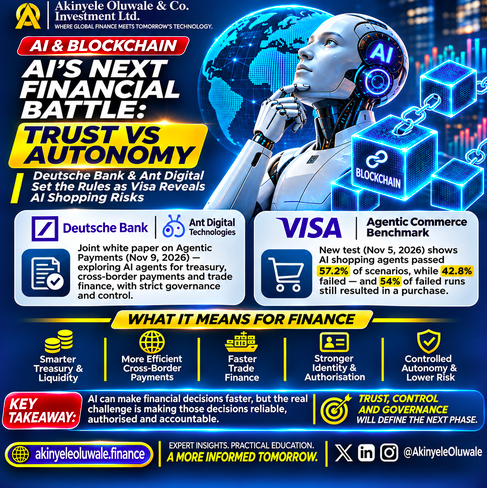
Artificial intelligence is moving from generating information to executing business transactions. As financial institutions introduce AI agents into payment systems, the competition is shifting toward identity verification, transaction security, financial accountability and the infrastructure needed to support trusted automation.
Publication date: November 11, 2026
Category: AI & Blockchain
Editorial focus: Agentic AI | Blockchain Infrastructure | Digital Identity | Autonomous Payments | Financial Security
The next phase of artificial intelligence will not be determined solely by which company develops the smartest chatbot or the most powerful language model. A more consequential competition is emerging. Financial institutions and technology companies are beginning to examine how AI systems can perform authorised commercial activities, interact with payment networks and operate within established financial controls.
This raises questions that go beyond software development. Who gives an AI agent permission to make a payment? How can a bank distinguish an authorised agent from a fraudulent automated system? What happens when an AI agent follows an incorrect instruction? And can blockchain technology provide a reliable way to record, verify or settle some of these transactions?
Recent developments involving Visa, IBM and emerging blockchain payment protocols demonstrate why these questions are becoming increasingly relevant. The important distinction is that AI provides the capability to act, while identity, governance and settlement infrastructure determine whether those actions can be trusted.
For investors, banks and businesses, this creates a new area of opportunity but also a new category of financial and operational risk.
Executive Summary
The latest developments in artificial intelligence and blockchain reveal an important change in global financial technology. The discussion is moving beyond whether AI can analyse information or whether blockchain can transfer digital assets. Financial institutions are now examining how AI agents can participate in treasury management, cross-border payments and trade finance without compromising financial controls.
On November 9, 2026, Deutsche Bank and Ant Digital Technologies jointly released a white paper titled Agentic Payments in Wholesale Finance. The publication examines how AI agents could support institutional financial operations while remaining subject to defined authorisation limits, identity verification and independent settlement controls.
Three applications receive particular attention:
Treasury and liquidity management.
Cross-border payment coordination.
Trade finance and documentary processing.
The paper advocates a model known as bounded agentic execution.
In simple terms, AI may analyse information and recommend financial actions, but its authority must remain limited, verifiable and subject to enforceable controls.
A second important development came from Visa. On November 5, Visa released its Agentic Commerce Benchmark, evaluating how effectively leading AI models handle realistic purchasing decisions. The results were revealing. Across the tested models and scenarios, the overall pass rate was 57.2%. That means 42.8% of test runs failed to satisfy the benchmark's requirements.
More concerning, 54% of failed runs still resulted in an attempted purchase decision. These findings raise questions about allowing AI agents to make financial decisions without adequate safeguards. Meanwhile, blockchain technology continues to be examined as potential infrastructure for programmable settlement, verifiable credentials and auditable transactions. However, blockchain cannot independently determine whether an AI agent has made a commercially sound decision.
Our institutional assessment is that the next phase of AI and blockchain will be defined by the ability to combine intelligent automation with independent financial controls.
Consider how a multinational company manages its money. It may hold funds in several currencies, operate bank accounts across different countries and make payments to suppliers worldwide. Its treasury department must decide when to transfer funds, which payment channels to use and how to manage foreign-exchange exposure.
Traditionally, these decisions involve financial professionals supported by banking systems and treasury-management software. Artificial intelligence introduces another possibility. An AI agent could analyse available cash balances, identify upcoming obligations, compare payment routes and recommend appropriate actions. For example, a company may need to pay a supplier $500,000.
An AI system could examine available liquidity, applicable foreign-exchange rates, transaction charges and settlement deadlines. It might recommend the most appropriate payment arrangement based on the company's approved policies. However, a recommendation is not the same as permission to execute.
The company must still determine whether the agent is authorised to initiate the transaction. It must also establish whether the payment complies with internal controls and applicable regulations. This is where the latest institutional research becomes important.
The central challenge is no longer simply making AI more capable. It is ensuring that financial authority remains controlled when AI becomes capable of acting.
On November 9, Deutsche Bank and Ant Digital Technologies announced their joint white paper on agentic payments in wholesale finance. This represents an important development because it brings the discussion of AI agents into established institutional banking functions. The paper examines how AI could assist financial institutions with complex decisions involving liquidity, international payments and trade finance.
It also addresses the governance requirements necessary before these capabilities can be used responsibly. The emphasis is not unrestricted autonomy. Instead, the proposed approach separates AI decision-making from independent controls and final payment execution. This distinction matters.
An AI agent may identify an opportunity to transfer funds between bank accounts but the institution must determine whether the transfer is permitted, whether sufficient liquidity exists and whether the transaction meets regulatory requirements. The paper is a framework for evaluating these possibilities. It should not be interpreted as evidence that Deutsche Bank has already deployed fully autonomous AI payment systems across its wholesale banking operations.
The lesson: Institutional AI adoption is increasingly focused on governance and practical financial applications rather than technology demonstrations alone.
The first major application identified by Deutsche Bank and Ant Digital Technologies concerns treasury management. Corporate treasury departments manage cash, funding requirements, financial risks and payment obligations. These responsibilities become more complicated when businesses operate across multiple countries.
Imagine a company with substantial cash in one subsidiary while another subsidiary faces a short-term funding shortage. An AI system could identify the imbalance and evaluate possible responses. These might include internal fund transfers, short-term financing or foreign-exchange transactions. However, the financial decision must account for restrictions on fund transfers, tax considerations, regulatory obligations and liquidity requirements.
An AI recommendation that ignores these factors could create serious problems. The proposed institutional approach therefore requires AI-generated recommendations to remain within approved financial policies.
The lesson: AI may improve treasury efficiency, but financial accountability must remain with the institution.
International payments involve more than sending money from one account to another. A transaction may require currency conversion, correspondent banking arrangements, regulatory checks and settlement through different financial systems.
These processes can create costs and delays.
AI agents may eventually help financial institutions compare payment routes and identify efficient execution arrangements. For example, an agent could evaluate whether a transaction should use a conventional banking channel or another approved settlement mechanism. Its assessment might consider cost, speed, liquidity, availability and regulatory compliance.
Blockchain-based settlement could become relevant where tokenized deposits or appropriately regulated stablecoins provide useful capabilities. However, the technology must be suitable for the transaction.
A faster blockchain transfer is not automatically a better payment if the recipient cannot redeem the funds efficiently. Likewise, lower transaction fees may be offset by conversion costs, compliance expenses or liquidity constraints.
The lesson: The objective of AI-driven payment coordination should be better financial outcomes, not simply greater automation.
Trade finance is another important application identified in the Deutsche Bank and Ant Digital Technologies paper. International trade often requires extensive documentation. Businesses may need to prepare invoices, shipping records, insurance documents and other information required under financing arrangements. Financial institutions must examine these documents and determine whether contractual conditions have been satisfied.
AI systems may assist by identifying discrepancies, extracting information and coordinating document reviews. For example, an AI agent could compare a commercial invoice with a purchase order and shipping documentation. If the quantities or values do not match, the system could flag the discrepancy. However, the agent should not automatically authorise payment merely because it has processed the documents.
The financial institution must still apply the appropriate approval and compliance procedures. Blockchain may offer benefits where multiple parties need access to reliable records or shared transaction information. Nevertheless, the usefulness of blockchain depends on legal recognition, interoperability and operational design.
The lesson: AI may reduce administrative friction in trade finance, but document verification and payment authority must remain properly controlled.
On November 5, Visa released its Agentic Commerce Benchmark. The research tested 22 AI models from 12 laboratories across 15 realistic shopping challenges. The models were expected to identify consumer requirements and make appropriate purchasing decisions.
The results were significant.
| Visa benchmark measure | Reported result |
|---|---|
| Overall pass rate | 57.2% |
| Overall failure rate | 42.8% |
| Best-performing model pass rate | 82.2% |
| Worst-performing model pass rate | 28.9% |
| Failed runs that still ended in a purchase | 54% |
| Scenarios where all three attempts succeeded | 34.2% |
These results highlight the difference between an AI agent that can complete a transaction and one that consistently makes an appropriate decision. For example, a customer may ask an AI assistant to purchase a television.
The assistant may need to establish the customer's budget, preferred specifications and compatibility requirements. If the agent fails to identify those requirements, it may purchase an unsuitable product. The payment could be technically successful while the purchasing decision remains incorrect.
This distinction is fundamental.
A successful payment does not necessarily mean a successful financial decision.
Visa's research is a benchmark of selected models and shopping scenarios, not a universal failure rate for all AI systems. Nevertheless, it provides useful evidence that reliability remains a challenge. The findings reinforce the importance of spending limits, approval procedures and transaction safeguards.
The convergence of AI and blockchain is often presented as though the two technologies must always operate together. That assumption is incorrect. Artificial intelligence and blockchain perform different functions. AI can analyse information, identify patterns, evaluate alternatives and generate recommendations. Blockchain can support shared records, programmable asset transfers and certain forms of verifiable transaction history.
Their combination may be useful in particular financial applications. For example, an AI agent could recommend a payment while a separate blockchain-based system executes an authorised transfer. A digital credential could help verify that the agent is associated with an approved organisation. A transaction record could provide evidence of the completed payment. However, blockchain does not automatically establish that the underlying transaction was appropriate.
An incorrect payment can still be recorded accurately on a blockchain. This is why financial governance must operate before and after settlement. The strongest architecture may involve three separate functions.
Decision-making: AI evaluates information and proposes an action. Control and authorisation: Independent systems determine whether the proposed action is permitted. Settlement: An approved financial infrastructure executes the transaction. The settlement system could use conventional banking infrastructure, tokenized deposits or a suitable blockchain arrangement.
The correct choice depends on commercial and regulatory requirements.
At Akinyele Oluwale & Co. Investment Ltd., we believe the latest developments reveal an important shift in financial technology. The industry is beginning to recognise that intelligence without accountability can create significant financial risk. An AI agent may process information faster than a human employee. It may compare thousands of data points and identify patterns that would otherwise require substantial manual effort but speed does not guarantee accuracy and accuracy in analysing information does not automatically establish authority to act.
Consider a company that allows an AI agent to manage supplier payments. The company may benefit from faster invoice processing. However, if the agent can independently change payment beneficiaries or exceed approved limits, the organisation may face serious financial exposure. The solution is not necessarily to reject AI automation. It is to design systems in which authority remains clearly defined. We believe five principles should guide institutional adoption.
First, identity must be verifiable. Every AI agent performing financial activities should be associated with an accountable organisation or authorised user.
Second, authority must be limited. An agent should not be able to extend its own permissions.
Third, financial controls must remain independent. The system recommending a transaction should not automatically possess unrestricted power to approve and execute it.
Fourth, transactions must be auditable. Institutions should maintain reliable records of instructions, approvals and completed actions.
Fifth, commercial value must be measurable. Reduced processing costs, improved accuracy and better liquidity management should justify investment in the technology.
These principles also provide a framework for evaluating blockchain applications. A blockchain solution should be adopted because it improves a financial process, not simply because it is associated with an emerging technology.
Our editorial assessment is that the next competitive advantage in financial technology will belong to institutions that combine intelligent automation with enforceable financial discipline.
Deutsche Bank and Ant Digital Technologies: Monitor whether the proposed framework progresses into broader institutional implementations. AI treasury applications: Look for evidence of measurable improvements in liquidity forecasting and payment efficiency. Visa's benchmark: Watch how AI models improve their ability to identify customer requirements and avoid unsuitable purchases. Agent identity: Monitor the development of verifiable credentials and delegated-authority controls. Blockchain settlement: Assess whether programmable digital payments provide advantages over conventional financial infrastructure. Stablecoin regulation: Follow developments affecting reserve backing, redemption and automated payment applications. Operational resilience: Examine how institutions manage system failures, cybersecurity and incorrect AI-generated instructions. Accountability: Watch how regulators and financial institutions assign responsibility for AI-initiated transactions. Commercial adoption: Distinguish research publications and pilot projects from production deployment and measurable transaction volumes.
These indicators will provide a more reliable assessment of progress than speculative claims about autonomous finance.
1. Deutsche Bank and Ant Digital Technologies published a joint white paper on agentic payments on November 9, 2026.
2. The paper focuses on treasury management, cross-border payments and trade finance.
3. Its central recommendation is to limit AI-agent authority through enforceable controls.
4. Visa's November 5 benchmark found an overall pass rate of 57.2% across its selected AI shopping tests.
5. In 54% of failed test runs, the AI still proceeded with a purchase.
6. AI transaction execution and sound financial decision-making are different capabilities.
7. Blockchain may support programmable settlement and verifiable records but cannot independently guarantee good financial decisions.
8. Identity verification, delegated authority and auditability are essential to institutional adoption.
9. AI and blockchain announcements should be assessed against actual commercial outcomes.
10. The long-term opportunity lies in trusted automation that improves financial efficiency without weakening accountability.
Akinyele Oluwale & Co. Investment Ltd. is an institutional financial intelligence platform focused on global financial markets, macroeconomics, central banking, institutional cryptocurrency, stablecoins, digital payments, tokenization, real-world assets, artificial intelligence and blockchain technology.
Our editorial mission is to explain important financial developments through evidence-based analysis, practical education and an institutional perspective.
We examine how emerging technologies, financial institutions and regulatory frameworks interact to shape the future of global finance.
Deutsche Bank and Ant Digital Technologies are examining how AI agents could support complex institutional financial activities.
Visa's research shows that AI shopping agents still face meaningful reliability challenges. Together, these developments reinforce a fundamental principle.
The ability to execute a financial transaction is not the same as the authority to execute it, and neither guarantees that the underlying decision is correct.
Artificial intelligence may improve the speed and quality of financial analysis. Blockchain may support programmable settlement and verifiable records but financial institutions must ensure that these technologies operate within credible governance arrangements. The future of autonomous finance will depend on balancing innovation with control. For banks, the priority is operational reliability. For businesses, it is efficiency without sacrificing accountability. For investors, it is distinguishing commercial value from technological excitement and for regulators, it is ensuring that new financial systems preserve appropriate safeguards.
The next financial revolution will not be defined by machines making unlimited decisions. It will be defined by institutions knowing precisely which decisions machines are authorised to make and maintaining control over the consequences.
Observe the change. Understand the implications. Position with discipline.
Akinyele Oluwale & Co. Investment Ltd.
Where Global Finance Meets Tomorrow's Technology.
Website: akinyeleoluwale.finance
Editorial disclaimer: This article provides general financial education and technology analysis. It does not constitute personalised investment advice or an endorsement of any particular cryptocurrency or financial product.