

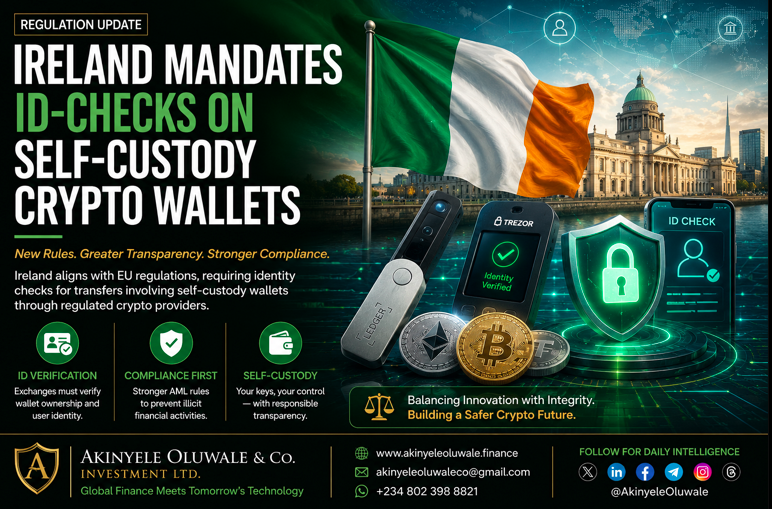
Ireland Tightens Crypto Transfer Checks: What the Rules Really Mean for Self-Custody Wallets
The headline sounds dramatic: Ireland is “mandating ID checks on self-custody wallets.” The reality is more nuanced. The rules do not outlaw private wallets or require every wallet itself to undergo KYC. They strengthen identity and traceability requirements when regulated crypto providers interact with self-hosted addresses.
Published: 14 August 2026
Category: Crypto & Digital Assets • Regulation • Europe • Self-Custody
By: Akinyele Oluwale & Co. Investment Ltd.
Executive Summary
The underlying regulatory direction is correct, but the viral headline needs qualification.
Ireland operates within the EU's crypto regulatory framework. Under the EU Transfer of Funds Regulation, crypto-asset service providers must collect information about the originator and beneficiary when they facilitate crypto transfers. The regulation specifically covers transfers involving self-hosted wallets whenever a regulated crypto service provider is involved. (Eur-Lex)
For transfers exceeding €1,000 between a customer and a self-hosted address, the provider must verify whether that address is owned or controlled by the customer. (Eur-Lex)
However, this is not the same as Ireland requiring every private crypto wallet to register or undergo government ID checks. Pure person-to-person transfers where no crypto-asset service provider is involved fall outside this particular regulation. (Eur-Lex)
The bigger story is clear: self-custody remains legal, but anonymity at regulated gateways is becoming increasingly difficult.
What Happened?
Ireland's crypto sector is now operating fully inside the EU's MiCA regime. The Central Bank of Ireland confirms that crypto-asset service providers require authorisation and face anti-money-laundering, prudential and conduct obligations. (Central Bank of Ireland - English)
The MiCA transitional period ended across EU member states on 1 July 2026, meaning firms serving EU consumers now need appropriate authorisation. Interestingly, the Central Bank itself explicitly lists moving assets to a self-hosted wallet as an option for consumers leaving unauthorised providers further evidence that self-custody itself has not been prohibited. (Central Bank of Ireland - English)
Context / Background
Europe's approach is built around the crypto Travel Rule.
When regulated providers transfer crypto, information identifying the sender and recipient must accompany the transaction. Unlike traditional fund transfers, EU rules provide no general low-value exemption for crypto transfers. (Eur-Lex)
Self-hosted wallets introduce a harder question because there may be no regulated institution on the other side.
The EU's answer is to place the compliance obligation on the regulated provider involved in the transaction.
For transfers above €1,000 involving a customer's self-hosted wallet, that can include verifying that the customer actually controls the address. (Eur-Lex)
Why It Matters
This represents an important evolution in crypto regulation.
For years, the distinction was relatively simple:
Exchange = identified.
Private wallet = pseudonymous.
That boundary is becoming more complicated.
A self-custody wallet can still exist independently, but the moment assets enter or leave a regulated exchange, the exchange may need substantially more information about where those assets came from or where they are going.
The regulatory focus is therefore shifting from controlling wallets to controlling regulated gateways.
Winners and Losers
Potential winners: compliant exchanges, blockchain analytics companies and institutional investors seeking stronger AML standards.
Potential losers: users relying on regulated platforms for anonymous transfers and service providers unable to meet increasingly demanding compliance requirements.
Self-custody users aren't automatically losers. They retain control of their private keys but should expect more questions when interacting with regulated financial infrastructure.
Short-Term Impact
Irish crypto users could encounter additional verification when depositing from or withdrawing to private wallets.
Depending on the provider and transaction, that might involve confirming wallet ownership or supplying information concerning the sender, recipient or source/destination of funds.
That adds friction but does not transfer custody of the private wallet to the exchange.
Long-Term Impact
The direction across Europe is increasingly clear:
Permissionless blockchain networks may remain open, while access points connecting those networks to regulated finance become increasingly permissioned.
That creates a two-layer system:
Open blockchain infrastructure underneath.
Regulated financial gateways above it.
How those layers coexist will become one of crypto's defining policy debates.
Editorial Perspective
The distinction between self-custody and anonymity is becoming critical.
Self-custody means:
You control your keys.
It does not necessarily mean:
A regulated institution can never ask who controls the wallet.
Those are different principles.
Regulators have legitimate concerns about money laundering and sanctions evasion. But policymakers must also avoid turning reasonable financial surveillance into unnecessary intrusion into lawful private activity.
The challenge is finding that balance.
What to Watch Next
Watch how Irish exchanges implement wallet-ownership verification, whether users experience withdrawal friction, how providers handle transactions below €1,000, and how forthcoming EU AML rules expand risk-based checks involving self-hosted addresses.
The EU's broader AML Regulation explicitly provides for risk-based measures concerning transactions with self-hosted addresses. (Eur-Lex)
Investing Lesson
Never confuse ownership with privacy.
Holding crypto in your own wallet gives you control over the asset.
It doesn't guarantee anonymity when that wallet interacts with regulated institutions.
As regulation evolves, investors increasingly need to understand three things:
Who controls the keys?
Who can identify the transaction?
Which regulatory gateway is involved?
That knowledge is becoming part of responsible crypto investing.
Key Takeaways
Editorial Bottom Line
Ireland isn't abolishing self-custody. Europe is making the bridge between self-custody and regulated finance more transparent.
That distinction matters.
The future debate will not simply be regulation versus crypto.
It will be about finding the right balance between financial integrity, individual privacy and the right to control your own digital assets.
Akinyele Oluwale & Co. Investment Ltd.
Global Finance Meets Tomorrow's Technology.