

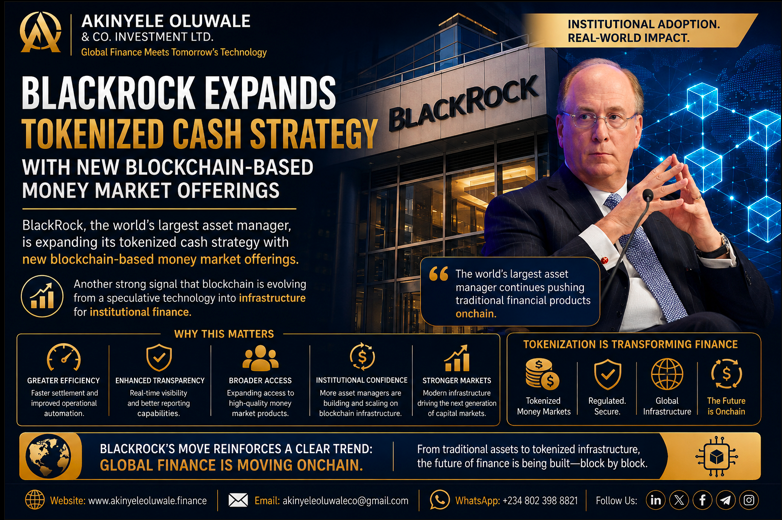
BlackRock Doubles Down on Tokenized Money Markets: Why the World's Largest Asset Manager Is Taking Traditional Finance On-Chain
BlackRock's latest expansion into blockchain-based money market products signals that tokenization is becoming a strategic priority for global asset managers not just a fintech experiment.
Published: 7 August 2026
Category: Tokenization & RWAs • Institutional Crypto • Asset Management • Global Markets
By: Akinyele Oluwale & Co. Investment Ltd.
Executive Summary
BlackRock, the world's largest asset manager, is expanding its tokenized cash strategy by introducing new blockchain-based money market offerings, reinforcing its commitment to bringing traditional financial products onto blockchain infrastructure.
While cryptocurrencies often dominate headlines, BlackRock's latest move highlights a different story unfolding behind the scenes. Rather than creating entirely new financial products, the firm is modernising familiar investment vehicles such as money market funds through tokenization.
This is another strong signal that blockchain is evolving from a speculative technology into infrastructure for institutional finance. As more asset managers adopt tokenization, the conversation is shifting from whether blockchain belongs in traditional finance to how quickly it can be integrated into global capital markets.
Why This Matters
This announcement is significant for several reasons.
It demonstrates that one of the world's most influential investment firms believes blockchain can improve how financial assets are managed and distributed.
It also reinforces several broader market trends:
When BlackRock expands an initiative, the broader financial industry usually pays attention.
What Happened?
BlackRock announced an expansion of its tokenized cash strategy, introducing additional blockchain-based money market offerings.
Money market funds have traditionally been viewed as low-risk, highly liquid investment products used by institutional investors, corporations, and treasury managers to preserve capital while earning short-term returns.
By placing these products on blockchain infrastructure, BlackRock aims to improve several aspects of fund operations, including:
Rather than replacing traditional financial markets, tokenization enhances how existing assets are issued, managed, and transferred.
This latest expansion builds on BlackRock's broader digital asset strategy, which already includes tokenized investment products and continued engagement with blockchain-based financial infrastructure.
The Bigger Picture
BlackRock's announcement fits within a much larger transformation taking place across global finance.
Over the past two years, major institutions have steadily increased investment in tokenization.
Recent examples include:
The common theme is clear.
Blockchain is no longer being viewed primarily as cryptocurrency technology.
Instead, it is increasingly being treated as infrastructure capable of modernising existing financial markets.
That distinction is important.
The objective is not to replace traditional finance.
It is to improve it.
Market Impact
Winners
Institutional Investors
Faster settlement and improved liquidity management could reduce operational friction while increasing market efficiency.
Asset Managers
Tokenization allows investment firms to distribute products more efficiently and potentially broaden investor access over time.
Treasury Teams
Tokenized money market funds could improve liquidity management by enabling faster movement of capital and more flexible cash allocation.
Blockchain Infrastructure Providers
Custodians, compliance platforms, digital transfer agents, and tokenization technology providers stand to benefit as adoption expands.
Challenges
Despite the momentum, several challenges remain.
Regulatory Alignment
Tokenized investment products continue operating under different regulatory frameworks across jurisdictions.
Market Liquidity
Secondary markets for tokenized financial products remain relatively small compared with traditional markets.
Technology Integration
Existing financial institutions must integrate blockchain infrastructure without disrupting established operational processes.
Investor Education
Many institutional and retail investors still associate blockchain primarily with cryptocurrencies rather than financial infrastructure.
Editorial Perspective
BlackRock's latest move reinforces a trend we have consistently highlighted:
Tokenization is no longer searching for a use case.
It has found one.
Money market funds may not generate the excitement of emerging cryptocurrencies, but they represent one of the largest and most important segments of global finance.
When the world's largest asset manager begins moving these products onto blockchain infrastructure, it signals confidence in the technology's long-term value.
What's particularly interesting is what BlackRock is not doing.
It is not replacing traditional money market funds.
It is not abandoning existing financial regulations.
Instead, it is improving the infrastructure beneath familiar investment products.
History suggests that the most transformative technologies often succeed quietly.
Investors rarely notice the underlying systems that make markets faster, more efficient, and more transparent.
But those systems ultimately shape how capital moves around the world.
BlackRock's continued investment suggests tokenization is increasingly becoming part of that invisible financial infrastructure.
What to Watch Next
Investors should monitor several developments over the coming months:
These developments will provide valuable insight into how quickly tokenization is becoming part of mainstream capital markets.
Key Takeaways
About Akinyele Oluwale & Co. Investment Ltd.
Akinyele Oluwale & Co. Investment Ltd. delivers research-driven intelligence covering Institutional Crypto, Tokenization & RWAs, Stablecoins & Payments, Artificial Intelligence, Global Macro, Central Banks, and Digital Assets.
Every article is built around five essential questions:
Global Finance Meets Tomorrow's Technology.