

Crypto Regulation Goes Global: Why More Countries Are Establishing Legal Frameworks for Digital Assets
From Japan to Nigeria, Governments Are Moving from Uncertainty to Regulation
By Akinyele Oluwale & Co. Investment Ltd.
🌐 www.akinyeleoluwale.finance
Executive Summary
Around the world, governments are increasingly replacing regulatory uncertainty with structured legal frameworks for digital assets. Jurisdictions across Asia, Europe, Africa, North America, South America, and the Middle East have introduced or advanced cryptocurrency legislation aimed at providing greater legal certainty, strengthening investor protection, and encouraging responsible innovation.
While the specific rules vary by country, the broader trend is clear: digital assets are becoming part of mainstream financial policy. For investors, businesses, and financial institutions, this shift signals a maturing global digital asset ecosystem.
A Global Shift Toward Crypto Regulation
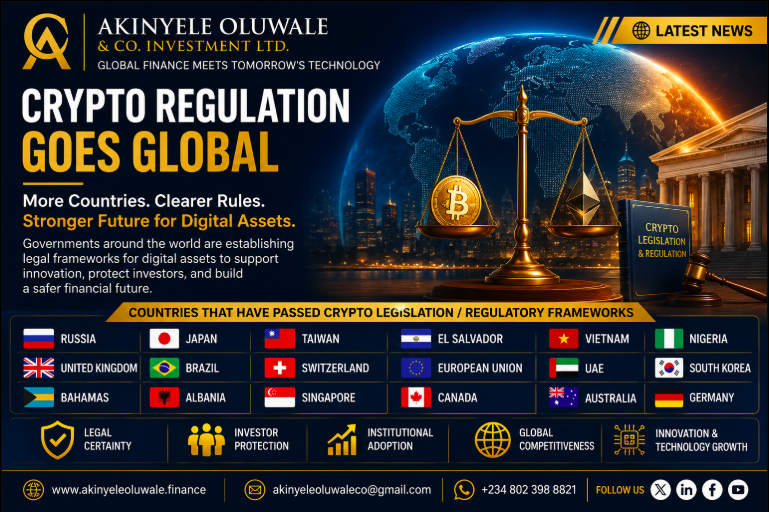
The image circulating on social media highlights a growing list of countries that have passed or introduced cryptocurrency-related legislation or regulatory frameworks, including:
Although each jurisdiction has adopted its own approach, the common objective is to provide legal clarity for digital asset markets.
Why Regulation Matters
For years, one of the biggest challenges facing the cryptocurrency industry has been regulatory uncertainty.
Without clear rules, businesses often face difficulties in:
Well-designed regulation can provide greater certainty for market participants while supporting innovation and protecting consumers.
The Evolution of Digital Finance
The conversation has moved far beyond Bitcoin alone.
Modern regulatory frameworks increasingly cover:
Governments are recognising that blockchain technology is becoming an important part of the future financial system.
Different Countries, Different Approaches
Although many countries are embracing regulation, they are not all following the same model.
Some jurisdictions focus on:
Innovation
Countries such as Singapore, Switzerland, and the UAE have sought to attract blockchain businesses by developing relatively clear regulatory environments.
Consumer Protection
Several jurisdictions place greater emphasis on safeguarding investors, improving disclosures, and strengthening oversight of digital asset service providers.
Financial Stability
Many governments are also assessing how stablecoins, tokenized assets, and digital payment systems may affect monetary policy and financial stability.
Nigeria's Position
Nigeria has become one of Africa's most active digital asset markets.
Recent regulatory developments demonstrate an increasing willingness by policymakers to establish clearer rules for virtual asset service providers while balancing innovation with financial oversight.
As blockchain adoption continues to grow across payments, remittances, and investment, regulatory clarity could strengthen Nigeria's position within Africa's digital economy.
The Global Race for Digital Finance Leadership
Competition among countries is no longer centred solely on traditional finance.
Increasingly, governments are competing to become hubs for:
Jurisdictions that provide predictable and transparent rules may be better positioned to attract investment, talent, and technological innovation.
What This Means for Investors
For investors, expanding regulatory frameworks may offer several potential benefits:
However, regulation does not eliminate investment risk. Digital assets remain subject to market volatility, technological risks, and evolving policy developments.
Akinyele Oluwale & Co. Investment Ltd. Insight
The global conversation has shifted from whether cryptocurrencies should be regulated to how they should be regulated.
This evolution reflects the increasing maturity of the digital asset industry. Rather than operating outside traditional financial systems, blockchain technology is becoming progressively integrated into mainstream finance through tokenization, stablecoins, regulated exchanges, and institutional investment products.
Countries that strike the right balance between innovation, market integrity, and investor protection are likely to shape the next generation of global financial infrastructure.
Final Thoughts
The growing number of countries establishing digital asset legislation demonstrates that blockchain is no longer viewed solely as an emerging technology.
It is increasingly recognised as a component of the future financial system.
While regulatory approaches will continue to evolve, the broader direction appears clear: governments are moving toward structured oversight rather than regulatory uncertainty.
For investors, businesses, and policymakers, understanding these developments will be essential as digital finance continues to expand globally.
About Akinyele Oluwale & Co. Investment Ltd.
Global Finance Meets Tomorrow's Technology
We provide institutional-grade analysis covering:
Helping investors understand:
🌐 Website: www.akinyeleoluwalefinance
📧 Email: akinyeleoluwaleco@gmail.com
💬 WhatsApp: +234 802 398 8821
Editorial Note
This article is intended for educational and informational purposes only. The image shared on social media summarises countries that have adopted some form of cryptocurrency legislation or regulatory framework, but the scope and maturity of those frameworks vary significantly by jurisdiction. Readers should refer to official government and regulatory sources for the latest legal requirements in any specific country.