

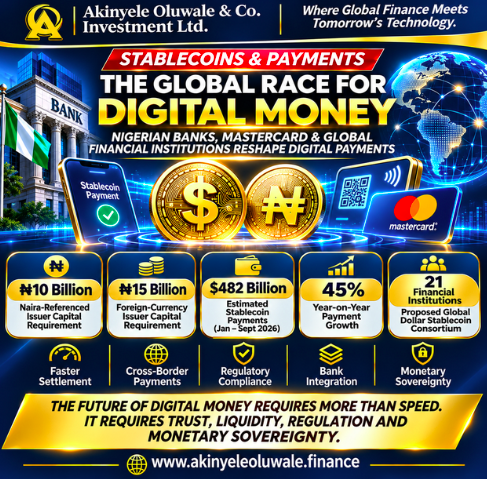
THE GLOBAL RACE FOR DIGITAL MONEY: WHY BANKS, PAYMENT GIANTS AND REGULATORS ARE REDEFINING THE FUTURE OF FINANCIAL SETTLEMENT
Stablecoins are increasingly being examined as instruments for international payments, corporate treasury management and institutional settlement. However, the transition towards programmable money raises important questions about monetary sovereignty, financial stability, liquidity and consumer protection.
Published: Thursday, 26 November 2026
Category: Stablecoins & Payments
By: Akinyele Oluwale & Co. Investment Ltd.
Editorial Focus: Digital Money | Stablecoins | Cross-Border Payments | Banking Infrastructure | Monetary Sovereignty | Financial Regulation
The global financial system is undergoing a transformation that extends far beyond conventional cryptocurrency trading. Banks, payment networks, financial technology companies and regulatory authorities are increasingly examining how digital currencies can improve the movement of money across institutions, businesses and international borders. At the centre of this transformation are stablecoins digital assets designed to maintain a relatively stable value against a reference asset, typically a national currency such as the United States dollar. Unlike Bitcoin and other cryptocurrencies whose prices fluctuate according to market conditions, stablecoins generally attempt to maintain a predetermined reference value.
However, maintaining that value requires credible financial arrangements, reliable redemption mechanisms and effective governance. The emerging institutional opportunity is not simply about issuing more digital currencies. It is about improving the infrastructure through which financial obligations are settled. International payments can involve multiple intermediaries, currency conversions, banking hours and reconciliation procedures. Stablecoin-based infrastructure could reduce some of these operational limitations. Nevertheless, technological efficiency does not automatically establish financial safety. The future of digital payments will depend on whether financial institutions can combine faster settlement with regulatory compliance, credible reserves, operational resilience and enforceable customer rights.
Our central assessment is that the competition surrounding stablecoins is increasingly becoming a competition over who controls, regulates and operates the next generation of global payment infrastructure.
The traditional international payment system was developed around networks of commercial banks, correspondent banking relationships, foreign-exchange markets and national settlement infrastructure. Although these arrangements remain essential to global commerce, they can involve operational delays, intermediary charges and restrictions associated with banking hours. Consider a Nigerian manufacturer importing equipment from Europe. The company may need to obtain foreign currency, initiate an international transfer, comply with regulatory requirements and wait for confirmation that its supplier has received payment. Each stage can introduce additional costs and uncertainty. Stablecoin-based settlement could potentially improve certain aspects of this process by allowing participating institutions to transfer digital representations of monetary value outside conventional banking hours. However, faster settlement does not eliminate the need for foreign-exchange liquidity, regulatory compliance or reliable banking relationships. This distinction is particularly important for emerging economies. A digital representation of the US dollar does not create additional dollar liquidity within the Nigerian economy. It changes how existing monetary value can be transferred and administered.
The real opportunity is not simply faster transactions. It is the development of more efficient, transparent and dependable financial infrastructure.
On 25 November 2026, BusinessDay reported that Nigerian financial institutions were becoming increasingly involved in discussions surrounding stablecoin infrastructure and international payments. The emerging business model involves cooperation between conventional banks, financial technology companies and digital asset service providers. Under such arrangements, commercial banks could provide regulated accounts, reserve custody, foreign-exchange liquidity and redemption services, while technology companies provide blockchain-based settlement capabilities. The development follows the introduction of Nigeria's regulatory framework for non-security virtual assets, which took effect on 5 November 2026. This represents an important change in the relationship between traditional banking and digital assets. Rather than being displaced by stablecoins, commercial banks could become essential intermediaries supporting their regulated use.
For institutional customers, the attraction may lie in accessing improved payment infrastructure without having to independently manage complex blockchain systems. However, the commercial viability of these arrangements remains dependent on regulatory approvals, liquidity and operational reliability. The institutional lesson: Stablecoin adoption may strengthen cooperation between banks and financial technology companies rather than eliminate conventional banking.
The Central Bank of Nigeria has introduced a regulatory framework governing stablecoins and other non-security virtual asset activities within its jurisdiction. The framework establishes separate requirements for naira-referenced and foreign-currency-referenced stablecoins. Among its reported provisions are:
A minimum paid-up capital requirement of ₦10 billion for naira-referenced stablecoin issuers.
A minimum paid-up capital requirement of ₦15 billion for foreign-currency-referenced stablecoin issuers.
Local incorporation and licensing requirements for foreign-currency stablecoin issuers serving the Nigerian market.
Reserve management and redemption arrangements involving regulated financial institutions.
Prohibition of algorithmic stablecoins.
Customer verification, transaction monitoring and financial-crime prevention requirements.
Existing operators have been given a transitional period of 180 days to seek the appropriate licences or authorisations, subject to applicable conditions. Importantly, the CBN's framework distinguishes regulatory approval from a guarantee of a stablecoin's financial value or convertibility. This means that regulatory recognition should not be interpreted as government protection against every possible financial loss. The broader significance is that Nigeria is attempting to bring stablecoin-related payment activities within a more structured supervisory environment. Nevertheless, the new framework does not establish that every existing stablecoin issuer has already obtained the required Nigerian licence.
The institutional lesson: Regulatory clarity is becoming a foundation for sustainable stablecoin adoption, but authorisation must not be confused with financial guarantees.
Mastercard's collaboration with African stablecoin infrastructure provider Yellow Card continues to attract attention as financial institutions explore new payment arrangements across emerging markets. The partnership, originally announced in May 2026 and highlighted again in BusinessDay's reporting on 25 November, targets markets including Nigeria, Ghana, Kenya, South Africa and the United Arab Emirates. Its intended applications include international remittances, business-to-business settlement and corporate treasury management. The commercial significance lies in combining Mastercard's established international payment infrastructure with blockchain-related financial technology.
African businesses frequently encounter challenges involving foreign-currency availability, fragmented payment systems and the cost of international transfers. Stablecoin infrastructure could address some operational inefficiencies, provided that appropriate regulatory and banking arrangements exist. However, the partnership should not be interpreted as confirmation that every proposed service is already commercially available across the identified countries. Implementation remains dependent on local conditions and regulatory permissions. The institutional lesson: The future of African payments may involve integration between conventional financial networks and digital settlement technology.
BusinessDay's 25 November report also highlighted Standard Bank's participation in a consortium of 21 financial institutions exploring the issuance of a reserve-backed US dollar stablecoin. Other reported participants include Goldman Sachs, Citi, Bank of America, Deutsche Bank, UBS, Santander and MUFG. The proposed digital currency is intended to support institutional, wholesale and potentially retail financial applications, including cross-border payments and digital asset settlement. Standard Bank's participation provides an important African dimension to the initiative. The development illustrates how established banks are increasingly evaluating whether they should participate directly in the issuance and administration of digital monetary instruments. Historically, stablecoin markets have been dominated by specialist digital asset companies. Greater involvement by commercial banks could introduce additional competition, alternative governance structures and closer integration with existing financial services. However, the proposed consortium stablecoin remains an initiative under development. It should not be described as an already operational global banking currency.
The institutional lesson: Competition in digital money is expanding beyond cryptocurrency companies to include some of the world's largest financial institutions.
An October 2026 report by CoinDesk, drawing on research from blockchain analytics company Allium, highlighted a notable development in stablecoin usage. The research estimated that stablecoin payments reached approximately $482 billion during the first nine months of 2026, representing year-on-year growth of 45%. Meanwhile, circulating stablecoin supply stood at approximately $305 billion at the end of September, having increased by only 0.4% since the beginning of the year. The number of identified payment transactions also increased considerably.
These figures suggest that stablecoins already in circulation may be supporting a growing number of payment activities. Economically, this is important because the usefulness of a monetary instrument cannot be evaluated exclusively through its outstanding supply. The frequency and purpose of its circulation also matter. Nevertheless, blockchain transaction volumes require careful interpretation. Transfers between exchanges, automated financial operations and internal movements of digital assets do not necessarily represent payments for goods and services. Allium's estimates attempt to distinguish payment activity from broader blockchain transfers.
The institutional lesson: Actual commercial usage is a more meaningful indicator of payment adoption than headline blockchain transaction volumes alone.
The most significant transformation in the stablecoin industry may not be visible to ordinary customers. In the future, a business could initiate an international payment through a conventional banking platform while selected components of the transaction are processed using blockchain-based infrastructure. The customer may not need to understand the underlying technology. What matters commercially is whether the payment is reliable, affordable, properly authorised and completed within a predictable timeframe. This potential transformation is already being examined by major payment networks. In September 2026, Visa and Lloyds Banking Group completed a seven-day pilot involving $750,000 in payment obligations settled using stablecoins. The institutions reported that funds arrived within an hour, including during the weekend.
Privately issued digital assets designed to maintain a reference value, supported by arrangements that vary according to their issuer and legal structure.
Digital representations of claims on commercial banks, operating under their respective banking and regulatory arrangements.
Digital forms of central bank money issued under the authority of national monetary institutions. Although these instruments may use related technologies, they have different legal characteristics, financial obligations and risk profiles. Understanding those differences will become increasingly important as digital payment infrastructure develops.
The next phase of monetary innovation will not necessarily produce one dominant form of digital money. It could produce several competing but interconnected financial instruments.
Commercial banks could develop additional business opportunities through reserve custody, payment processing, redemption services and institutional treasury management. However, they must manage regulatory obligations, technology expenditure, liquidity requirements and operational risks. Banks that integrate new financial infrastructure successfully may improve customer experience and diversify certain sources of revenue.
Established stablecoin issuers could benefit from growing institutional demand for reliable digital settlement instruments. Nevertheless, increasingly demanding local licensing requirements may increase compliance costs and create difficulties for issuers operating across multiple jurisdictions. Reserve credibility, redemption reliability and transparent governance will remain important competitive considerations.
Companies such as Visa and Mastercard are exploring how to integrate blockchain-based settlement into their existing international payment ecosystems. Their commercial opportunity lies in connecting different forms of money while preserving established financial relationships and customer protections. The objective is not necessarily to replace existing payment methods, but to expand the infrastructure available to participating institutions.
Fintech businesses could develop services involving institutional payment connectivity, financial compliance, transaction monitoring and reconciliation. However, commercial success will depend on regulatory permissions, genuine customer demand and sustainable business models.
Blockchain networks may experience additional activity as financial institutions explore digital payment and settlement applications. Nevertheless, increased network usage does not automatically establish that an associated cryptocurrency will appreciate in value. Commercial adoption, network economics and cryptocurrency valuations are related but distinct considerations.
Nigeria's position within the African digital asset economy deserves particular attention. Demand for international payment services reflects genuine economic circumstances, including foreign-exchange constraints, international trade requirements, remittances and currency uncertainty. Dollar-referenced stablecoins may appear commercially useful because of the US dollar's established role in international commerce. However, widespread dependence on privately issued digital dollars presents important macroeconomic questions.
Monetary sovereignty refers to a country's capacity to manage its domestic monetary system and implement effective monetary policy. If businesses and households increasingly conduct domestic economic activities using foreign-currency instruments, demand for the national currency could weaken. Under certain circumstances, this could complicate monetary policy transmission and exchange-rate management.
Stablecoin technology can facilitate the transfer of digital value, but it cannot independently increase a country's export earnings or foreign-exchange reserves. Nigeria still requires sustainable sources of foreign-currency inflows through exports, foreign investment, remittances and productive economic activity. Technology cannot substitute for those fundamentals.
The development of appropriately regulated naira-referenced digital instruments could potentially support domestic financial innovation. However, their long-term credibility would depend on reserve arrangements, reliable redemption, acceptance and confidence in the underlying currency. A digital representation of the naira remains economically connected to the naira. It does not automatically protect purchasing power against inflation or exchange-rate depreciation.
African economies could benefit if digital settlement infrastructure reduces unnecessary transaction costs and improves the predictability of international payments but the total cost must be evaluated from beginning to end. A low blockchain transaction fee does not necessarily mean that the overall payment is inexpensive once currency conversions, compliance costs and banking charges are included.
Reliable internet connectivity, electricity, digital literacy and consumer protection remain essential conditions for sustainable financial innovation. African countries cannot achieve comprehensive financial inclusion simply by introducing additional digital tokens.
Nigeria's long-term opportunity lies in developing efficient digital payment infrastructure without compromising monetary sovereignty, financial stability or confidence in the national currency.
At Akinyele Oluwale & Co. Investment Ltd., our institutional assessment is that stablecoins represent an important development in financial technology, but their commercial and economic significance must be assessed objectively. The growing involvement of commercial banks, international payment networks and financial regulators indicates that stablecoins are no longer being examined exclusively within cryptocurrency trading environments. Their potential applications increasingly involve legitimate financial activities, including institutional settlement, treasury administration and international commerce. However, five fundamental principles must guide their development.
First, reserves must be credible.
A stablecoin's ability to maintain its reference value depends substantially on its reserve structure and the financial obligations of its issuer.
Second, redemption must be dependable.
A digital asset claiming to represent a national currency must have clearly defined arrangements governing conversion and redemption.
Third, regulatory compliance must be meaningful.
Financial innovation should not undermine anti-money laundering requirements, consumer protection or financial-system integrity.
Fourth, operational efficiency must be measurable.
Stablecoin infrastructure should demonstrate genuine improvements in transaction costs, settlement speed, transparency or liquidity management.
Fifth, monetary sovereignty must remain protected.
Emerging economies must carefully evaluate the consequences of excessive dependence on foreign-currency digital instruments.
Our concern is that public discussion frequently concentrates on the speed of blockchain transactions while paying insufficient attention to the financial arrangements supporting those transactions.
Moving digital value quickly is only one part of the payment process. The value must remain credible. The transaction must be properly authorised. The recipient must have dependable access to the funds and legal accountability must remain identifiable.
The future of stablecoins will be determined not simply by how quickly digital money moves, but by how reliably it functions within the real economy.
As the global economy approaches December 2026 and the beginning of 2027, several important developments deserve continued observation. Nigeria's regulatory implementation: How the CBN administers its new licensing framework and how existing stablecoin operators respond to the transitional requirements.
Commercial bank participation: Whether Nigerian banks announce specific, authorised stablecoin-related financial services. International stablecoin issuers: Whether established issuers pursue the necessary local regulatory approvals and banking arrangements in Nigeria. Mastercard's African expansion: Whether its collaboration with Yellow Card progresses into approved commercial payment services across emerging markets. Global banking consortium: Whether the proposed dollar-backed stablecoin advances from institutional planning towards regulatory approval and operational deployment. Stablecoin reserves: Whether issuers maintain transparent reserve-management and dependable redemption arrangements. Commercial payment volumes: Whether growth in actual payments continues independently of cryptocurrency trading and automated blockchain activity. African monetary sovereignty: How regulators balance the potential benefits of digital settlement against the risks associated with foreign-currency dependence. Institutional settlement efficiency: Whether banks and payment networks demonstrate sustained improvements in transaction costs, liquidity management and settlement reliability. These developments should be evaluated through official regulatory disclosures, institutional announcements and measurable commercial evidence.
Nigerian banks are exploring deeper integration with stablecoin payment infrastructure.
Nigeria's new regulatory framework for non-security virtual assets took effect on 5 November 2026.
The reported minimum capital requirements are ₦10 billion for naira-referenced stablecoin issuers and ₦15 billion for foreign-currency-referenced issuers.
Mastercard and Yellow Card are pursuing stablecoin-related payment opportunities across emerging markets.
Standard Bank is participating in a reported 21-institution consortium exploring a reserve-backed dollar stablecoin.
Stablecoin payment activity reached an estimated $482 billion during the first nine months of 2026, according to Allium research reported by CoinDesk.
Faster blockchain settlement does not eliminate foreign-exchange constraints.
Regulatory approval does not guarantee a stablecoin's value or convertibility.
Digital dollarisation presents potential challenges for emerging-market monetary sovereignty.
Sustainable stablecoin adoption requires credible reserves, dependable redemption, regulatory compliance and measurable economic usefulness.
Akinyele Oluwale & Co. Investment Ltd. is an independent financial intelligence and research platform covering global macroeconomics, institutional cryptocurrency, central banking, stablecoins, digital payments, tokenization, real-world assets, artificial intelligence and blockchain technology. Our editorial mission is to explain how technological innovation, economic fundamentals, institutional decisions and regulatory developments are transforming the global financial system. We believe responsible financial journalism must distinguish technological capability from commercial reality, regulatory recognition from financial guarantees, and genuine economic innovation from speculation. Our analytical approach combines institutional research, economic reasoning and financial education to promote a deeper understanding of emerging financial technologies.
The latest developments within Nigeria and across international financial markets reinforce an important conclusion. Stablecoins are increasingly becoming a financial infrastructure story rather than exclusively a cryptocurrency story. Commercial banks are exploring their potential applications. Payment networks are developing alternative settlement capabilities. Financial technology companies are seeking closer integration with regulated institutions and central banks are establishing frameworks intended to protect monetary and financial stability. However, the emergence of faster digital payment infrastructure does not eliminate the fundamental economic responsibilities associated with money.
Money must remain credible. Financial obligations must remain enforceable. Reserves must be dependable. Transactions must be properly authorised and monetary sovereignty must not be sacrificed in the pursuit of technological convenience.
For Nigeria and Africa, the greatest opportunity is not simply to participate in the global stablecoin market. It is to develop financial infrastructure that supports productive businesses, facilitates legitimate international commerce, reduces unnecessary payment costs and strengthens economic resilience.
THE FUTURE OF DIGITAL MONEY WILL NOT BE WON BY THE FASTEST BLOCKCHAIN ALONE. IT WILL BE WON BY FINANCIAL SYSTEMS CAPABLE OF COMBINING SPEED, TRUST, LIQUIDITY, REGULATION AND ECONOMIC VALUE.
Observe the change. Understand the implications. Position with discipline.
Akinyele Oluwale & Co. Investment Ltd.
Where Global Finance Meets Tomorrow's Technology.
www.akinyeleoluwale.finance
Editorial disclaimer: This publication is intended for general financial education, economic research and institutional analysis. It does not constitute personalised investment advice, an endorsement of any stablecoin or a guarantee of financial performance.