

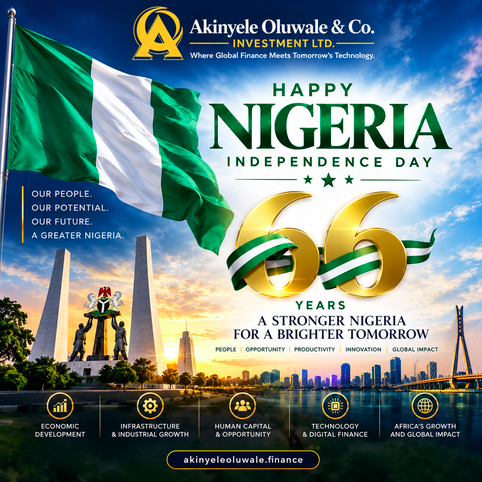
Nigeria at 66: Independence, Economic Transformation and the Next Chapter of Prosperity
Published: October 1, 2026
Category: Macro & Global Markets
By: Akinyele Oluwale
Sixty-six years ago, on 1 October 1960, Nigeria became an independent nation.
Today, as we commemorate another Independence Day, the occasion should be more than a celebration of history.
It should also be a moment to ask a forward-looking question:
What must Nigeria build in the decades ahead to translate its enormous human and economic potential into sustainable prosperity?
Independence gave Nigeria political sovereignty.
The continuing national challenge is to strengthen the foundations for economic sovereignty, productive capacity, technological competitiveness and broadly shared opportunity.
From Political Independence to Economic Capacity
Nigeria possesses significant advantages: a large population, entrepreneurial energy, natural resources, an expanding technology ecosystem and a substantial diaspora but national prosperity is not created by potential alone.
It requires institutions capable of supporting investment, businesses capable of competing internationally, infrastructure that lowers the cost of production, human capital that increases productivity and policies that encourage long-term capital formation.
This is particularly important as the global economy changes.
Artificial intelligence is transforming industries.
Digital financial infrastructure is changing payments and settlement.
Tokenization is creating new models of ownership and capital formation.
Global supply chains are being reorganised.
Energy systems are evolving.
Capital is becoming increasingly mobile.
Nigeria cannot afford merely to consume these transformations.
We must participate in creating them.
Nigeria's Financial Markets Matter
There are encouraging signs of what is possible.
Earlier in 2026, Nigerian equities recorded exceptionally strong dollar-denominated performance, supported by factors including improved foreign-exchange liquidity and stronger investor sentiment. Channels Television but one period of strong market performance should not be confused with completed economic transformation.
The deeper objective should be the development of financial markets capable of directing domestic and international capital toward productive Nigerian enterprises.
Capital markets should help finance infrastructure.
Banks should support productive businesses.
Technology should reduce financial friction.
Digital finance should expand access and efficiency.
And investment should ultimately contribute to productivity, employment and sustainable economic growth.
The Digital Economy Is an Opportunity Nigeria Must Take Seriously
One of Nigeria's greatest opportunities lies at the intersection of finance and technology.
Nigeria already has a large digitally connected population and an entrepreneurial technology sector.
The next stage must go further.
We should think seriously about the infrastructure required for a future involving digital identity, interoperable payments, artificial intelligence, blockchain applications, tokenized assets and increasingly digital financial markets.
Nigeria's digital-identity framework has continued evolving; in June 2026, the government signed a new National Identity Management Commission Act, describing improved identity infrastructure as part of efforts to strengthen public-service delivery, security and the digital economy. State House
The strategic opportunity is bigger than any individual technology.
It is about building the rails on which the next generation of Nigerian commerce can operate.
Human Capital Remains the Ultimate National Asset
Technology alone cannot transform a country.
People do.
Nigeria's young population can become one of its greatest economic advantages but only when education, skills, health, infrastructure and economic opportunity allow human potential to become productive capacity.
The future global economy will increasingly reward knowledge.
Data science.
Artificial intelligence.
Financial technology.
Engineering.
Advanced manufacturing.
Investment management.
Cybersecurity.
Digital entrepreneurship.
Nigeria therefore needs not merely more graduates, but increasingly globally competitive skills.
Independence Must Also Mean Building
Every generation inherits a different national responsibility.
The generation that fought for independence pursued political self-determination.
Subsequent generations strengthened democratic government and built institutions through periods of substantial national difficulty.
Our generation faces another responsibility:
building a productive, technologically competitive and financially sophisticated Nigerian economy.
That responsibility belongs not only to government.
Entrepreneurs must build.
Investors must allocate capital intelligently.
Businesses must create value.
Professionals must maintain standards.
Educational institutions must develop skills.
Citizens must demand accountable institutions.
And policymakers must create conditions in which productive enterprise can flourish.
Nigeria's own presidential messaging in 2026 has similarly framed prosperity as a generational national responsibility, while acknowledging that the country's democratic and economic development remains unfinished. State House
Nigeria and the Future of Global Finance
Nigeria should not view itself simply as Africa's largest population.
Its ambition should be greater.
A country with Nigeria's scale should aspire to become a significant centre for African capital markets, technology, digital finance, entrepreneurship and cross-border investment.
Lagos can deepen its position as an international financial and technology centre.
Nigerian companies can expand across Africa.
Nigerian professionals can participate more deeply in global capital markets.
And Nigerian innovation can solve problems extending far beyond our borders.
But none of this is automatic.
It requires consistency, credible institutions, infrastructure, human-capital development, investment and long-term thinking.
At 66, Look Forward
Independence Day naturally invites us to remember where Nigeria came from.
But its greater value may be in forcing us to consider where Nigeria is going.
The next chapter of Nigerian prosperity will not be written by optimism alone.
It will be written through productivity.
Investment.
Innovation.
Education.
Institutions.
Technology.
And disciplined execution.
At Akinyele Oluwale & Co. Investment Ltd., we believe Nigeria's future must include a stronger position within the emerging architecture of global finance and technology.
The opportunity is enormous.
The work required is equally enormous.
As Nigeria marks 66 years of independence, we celebrate the country while recognising that genuine economic transformation remains a continuing national project.
May the decades ahead be defined not simply by Nigeria's potential, but by its ability to convert that potential into prosperity.
Happy 66th Independence Day, Nigeria.
Akinyele Oluwale
Founder & Chief Investment Strategist
Akinyele Oluwale & Co. Investment Ltd.
Where Global Finance Meets Tomorrow’s Technology.