

Published: October 19, 2026
Category: Macro & Global Markets
By: Akinyele Oluwale
The next development challenge is not simply finding more capital. It is directing capital toward productive investment that creates jobs, raises incomes and strengthens the capacity to repay.
The 2026 IMF World Bank Annual Meetings ended in Bangkok with a difficult message for developing economies.
Capital is needed more urgently, but traditional sources of development financing are becoming increasingly constrained.
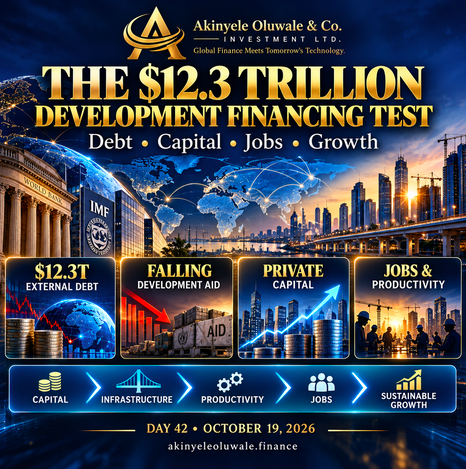
Developing countries' external debt has reached approximately $12.3 trillion, while official development assistance fell 23% in 2025, according to reporting from the meetings. At the same time, higher borrowing costs are placing greater pressure on government budgets. Reuters
For poorer countries, average debt-service payments are now consuming approximately 14% of government revenues. Reuters
Yet the financing challenge coincides with an even larger demographic challenge.
World Bank Group President Ajay Banga told the Annual Meetings that over the next 10–15 years approximately 1.2 billion young people will reach working age in developing countries, while current projections suggest only around 400 million jobs will be available. World Bank
That potentially leaves an employment gap approaching:
The development equation is therefore becoming increasingly difficult:
High Debt → Expensive Debt Service → Less Fiscal Space → Falling Aid → Private-Capital Need → Productive Investment → Jobs & Growth
The central question is no longer simply:
Where will developing economies find money?
It is:
Debt itself is not automatically harmful.
Borrowing can finance infrastructure, electricity, transport, education, healthcare, digital connectivity and productive businesses.
The critical question is what happens after the money is borrowed.
If capital increases productive capacity, future economic growth can help support repayment.
But when debt servicing grows faster than government revenues, fiscal space contracts.
Governments then have less capacity to fund:
This is the danger facing many developing economies.
The G24 warned during the meetings that developing nations face a significant debt burden alongside elevated borrowing costs and fiscal pressures that constrain inclusive growth. Reuters
The issue therefore extends beyond debt sustainability.
It becomes a question of economic opportunity.
Three developments converged during the Annual Meetings.
Developing countries' external debt reached approximately:
That represents obligations accumulated across governments, corporations and other borrowers—not a single government debt figure. Reuters
Official development assistance declined 23% during 2025, reported as the largest annual decline on record. Reuters
Banga told delegates:
1.2 billion young people → approximately 400 million projected jobs
over the coming 10–15 years. World Bank
This creates an enormous economic challenge.
Countries need investment precisely when governments and traditional donors have less room to provide it.
That explains why private capital mobilisation became one of the central themes of the 2026 Annual Meetings.
The World Bank says it mobilised a record $112 billion in private capital and issued $25 billion in guarantees in FY2026. World Bank Live
The development-finance model is changing.
For decades, development financing could broadly be understood as:
That model is not disappearing.
Public and concessional finance remain particularly important for poorer and more vulnerable economies.
But the emerging architecture increasingly looks like:
Banga explicitly described the future of development as bringing together public finance, private investment, philanthropy and technology, with the mix changing as countries develop. World Bank
This represents a major strategic shift.
Governments cannot finance everything.
Multilateral institutions cannot finance everything.
Private investors cannot solve every development problem.
The challenge is therefore to allocate risk intelligently.
Public and multilateral capital can potentially absorb or reduce risks that private investors are unwilling to accept.
That can help mobilise larger pools of private investment.
But there is an essential condition:
Private capital is not automatically development capital.
Its economic contribution depends on where it goes and what it produces.
The investment chain we should watch is:
Each link matters.
Countries require financing.
But capital alone is an input not an outcome.
Investment in electricity, transportation, telecommunications, water and digital infrastructure can reduce the cost of doing business.
Better infrastructure and technology can enable workers and companies to produce more efficiently.
Productive companies expand economic activity, investment and entrepreneurship.
Business expansion can create employment.
Productive employment raises household earning capacity.
Higher productivity and incomes can expand economic output and potentially strengthen government revenues.
That final stage matters for debt sustainability.
The strongest development-finance model is therefore not:
Borrow → Spend → Borrow Again
It should increasingly aim for:
That is the difference between financing consumption and financing productive economic capacity.
The $12.3 trillion headline is important.
But debt is not the only story.
The deeper story is a global capital-allocation problem.
The developing world needs enormous investment in infrastructure, businesses, technology and human capital.
At the same time:
Aid is declining.
Debt-service burdens are elevated.
Fiscal space is constrained.
Borrowing costs remain difficult.
The employment requirement is expanding.
That combination creates a fundamental challenge for development finance.
The solution cannot simply be:
Nor can it simply be:
The better objective is:
Capital that expands electricity generation.
Capital that improves transportation.
Capital that builds digital infrastructure.
Capital that increases agricultural productivity.
Capital that helps viable businesses expand.
Capital that improves skills.
Capital that ultimately creates sustainable employment.
This is why job creation has become central to the World Bank's strategy. World Bank
The next development challenge is not simply finding more capital. It is directing capital toward productive investment that creates jobs, raises incomes and strengthens the capacity to repay.
Watch whether multilateral institutions, governments and private creditors develop faster mechanisms for countries experiencing unsustainable debt burdens.
Falling policy rates alone will not solve the problem if sovereign risk premiums and long-term borrowing costs remain elevated.
The critical metric should not simply be the amount of capital announced.
Watch the progression:
Capital Mobilised → Capital Disbursed → Projects Delivered → Productivity Improved → Jobs Created
Energy, transportation and digital connectivity remain essential foundations for private-sector growth.
The development question is shifting from whether emerging economies can access technology to whether technology can improve productivity and create economic opportunity.
Indeed, the World Bank's Global AI & Digital Summit begins today, October 19, immediately after the Annual Meetings, with jobs, productivity and broader economic opportunity at the centre of the agenda. World Bank
Africa deserves particular attention because demographics make the jobs challenge especially consequential.
Infrastructure + skills + investment climate + productive capital will increasingly determine whether demographic growth becomes an economic dividend.
1. Developing-country external debt has reached approximately $12.3 trillion. Reuters
2. Official development assistance fell 23% in 2025, increasing pressure to find alternative financing models. Reuters
3. Debt service is consuming roughly 14% of government revenue on average among poorer countries. Reuters
4. Around 1.2 billion young people are expected to reach working age in developing countries over the next 10–15 years, against approximately 400 million projected jobs. World Bank
5. Private capital will therefore become increasingly important—but capital mobilisation alone is not success.
6. The ultimate test is productive economic impact.
High Debt → Expensive Debt Service → Less Fiscal Space → Private-Capital Need → Productive Investment → Jobs → Growth
And our economic-value framework:
Akinyele Oluwale & Co. Investment Ltd. provides financial intelligence at the intersection of global finance, macroeconomics and emerging technology.
Our coverage includes artificial intelligence, blockchain technology, crypto and digital assets, institutional finance, stablecoins and payments, tokenization and real-world assets, central banks, and global macroeconomic developments.
Our objective is to move beyond headlines to understand:
What changed?
Why does it matter?
Where could capital move next?
What are the long-term implications for investors, institutions and economies?
Observe the change.
Understand the implications.
Position with discipline.
Akinyele Oluwale & Co. Investment Ltd.
Where Global Finance Meets Tomorrow's Technology.
Day 40: The Global Liquidity Reset Why Interest Rates, Government Debt and Central-Bank Policy Could Determine Where Capital Moves Next
Day 41: Wall Street's Tokenization Shift Why Goldman Sachs, Morgan Stanley and Wells Fargo Are Beginning to See Tokenized Finance as an Opportunity Not a Threat
Day 35: Nigeria's $5.79 Billion Investment Test From Financing Commitments to Real Economic Impact
Day 37: Private Capital's Big Test Can Global Finance Turn Investment Into Jobs, Infrastructure and Sustainable Growth?