

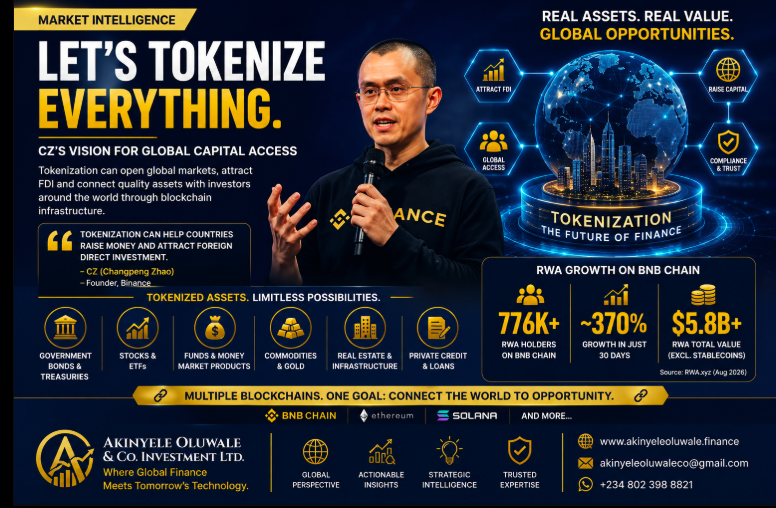
“Let’s Tokenize Everything”: CZ’s RWA Vision Highlights a Bigger Race to Put Global Capital On-Chain
Changpeng Zhao argues tokenization could help countries attract foreign capital by making assets globally accessible. The timing is notable: BNB Chain’s RWA ecosystem is expanding rapidly, while tokenized equities, Treasuries and funds are becoming increasingly important across blockchain finance.
Published: 21 August 2026
Category: Tokenization & RWAs • Institutional Finance • Market Intelligence
By: Akinyele Oluwale & Co. Investment Ltd.
Executive Summary
“Let’s tokenize everything.”
That was the message from Binance founder Changpeng “CZ” Zhao as he argued that tokenization could become a tool for countries and companies to broaden access to global capital.
The underlying idea is powerful: instead of an asset being confined primarily to a domestic exchange, jurisdiction or investor base, tokenization can potentially create digital representations that are distributed through blockchain networks to eligible investors globally.
His comments come as BNB Chain experiences remarkable RWA growth. RWA.xyz currently shows roughly $5.8 billion in distributed RWA value on BNB Chain. Its holder count has been climbing exceptionally quickly, although the exact figure is changing almost daily. (RWA)
The bigger story is not BNB Chain alone.
Tokenization is becoming a competition to build global distribution rails for capital.
What Happened?
CZ argued that tokenization could help countries “raise money” or attract foreign direct investment by opening assets to a much wider investor audience.
He also supported tokenization across multiple blockchains rather than concentrating everything on one network.
That creates an obvious trade-off.
More blockchains can encourage experimentation, competition and distribution but they can also fragment liquidity.
CZ's answer is interoperability: different issuers and networks ultimately need to communicate effectively if tokenized markets are to scale.
Meanwhile, BNB Chain's numbers provide important context. Binance Research reported that its tokenized RWA market capitalisation grew from approximately $1.9 billion to $3.8 billion during the first half of 2026, while tokenized equities rose particularly quickly. (Bnbstatic)
Background
Tokenization converts ownership or economic exposure to an asset into a blockchain based representation.
Potential assets include:
Stocks → Bonds → Treasuries → Funds → Commodities → Real Estate → Private Credit
The attraction is straightforward.
Traditional financial markets remain divided by geography, trading hours, intermediaries, settlement systems and investor-eligibility rules.
Blockchain can potentially create a more programmable distribution layer.
BNB Chain now hosts tokenized products associated with major financial names and issuers, including Treasury, money-market, equity and gold products. (BNB Chain)
Why It Matters
CZ's FDI argument deserves attention but also qualification.
Tokenization cannot automatically create foreign direct investment in the traditional economic sense. Buying a tokenized financial asset is not necessarily equivalent to establishing a factory, acquiring a controlling business interest or making another conventional direct investment.
But tokenization can broaden international capital access.
Imagine governments or companies issuing compliant tokenized bonds, infrastructure securities or investment funds that qualified investors can access across borders.
For emerging economies especially, better digital distribution could eventually widen the pool of potential capital.
The opportunity is therefore real, even if tokenization alone cannot solve the institutional, currency, governance or political risks that influence international investment.
Winners & Losers / Key Stakeholders
Countries with credible regulation and attractive assets could gain new distribution channels.
Companies could reach investors beyond their domestic capital markets.
Banks, custodians, asset managers and tokenization platforms could become essential infrastructure providers.
Blockchains such as BNB Chain, Ethereum, Solana and others will compete for issuance, liquidity and settlement activity.
The losers could be inefficient intermediaries whose value depends mainly on market fragmentation.
Short-Term Impact
Expect competition between blockchains to intensify.
BNB Chain already claims more than 700 tokenized stocks and ETFs, with cumulative tokenized-stock volume exceeding $5 billion according to the network's own June figures. (BNB Chain)
But investors should distinguish number of holders, asset value and genuine liquidity.
Rapid wallet growth is encouraging; it does not automatically mean deep, sustainable markets.
Long-Term Impact
The bigger transformation could be the globalisation of asset distribution.
A Nigerian infrastructure project, Asian bond, European fund or American equity could eventually have compliant digital representations accessible through interoperable financial networks.
That doesn't eliminate national laws.
It changes the technology through which capital reaches assets.
If interoperability improves, tokenization could gradually make capital markets more connected, programmable and continuously accessible.
Editorial Perspective
“Tokenize everything” is an exciting vision.
But the winning formula isn't:
Tokenize everything and ask questions later.
It is:
Tokenize quality assets + credible legal rights + compliance + liquidity + interoperability.
Technology can widen the door.
Trust determines whether serious capital walks through it.
For investors, the opportunity is therefore bigger than selecting the blockchain with the fastest RWA-holder growth.
Follow assets, liquidity, settlement and institutional participation.
What to Watch Next
Watch BNB Chain's RWA growth, particularly whether its extraordinary increase in holders translates into sustained trading and collateral activity.
Also watch tokenized equities, government securities and cross-chain interoperability.
The ultimate winner may not be one blockchain.
It may be the infrastructure capable of making assets portable across multiple financial networks.
Investing Lesson
Distribution expands opportunity. Fundamentals determine value.
Tokenizing a weak company, bad loan or poorly governed project does not make it investable.
Tokenization can improve access.
It cannot replace due diligence.
Key Takeaways
BNB Chain's RWA expansion gives CZ's comments important context: tokenized finance is moving quickly from theory toward active competition among networks. (Bnbstatic)
But the real prize is larger than RWA rankings.
It is global capital distribution.
Editorial Bottom Line
The internet globalised information.
Blockchain may increasingly globalise ownership and financial distribution.
If tokenization succeeds, countries and companies may eventually reach pools of capital that were previously difficult or expensive to access.
But the winning model won't simply be:
“Tokenize everything.”
It will be:
Tokenize responsibly. Connect globally. Build liquidity. Earn trust.
Notes
Market data and supporting research: RWA.xyz, Binance Research and BNB Chain ecosystem reporting. RWA.xyz currently tracks more than $38 billion of distributed RWA value across 39 networks, excluding the much larger stablecoin market. (RWA XYZ)
Akinyele Oluwale & Co. Investment Ltd.
Where Global Finance Meets Tomorrow’s Technology.