

Published: October 27, 2026 | Category: AI | By: Akinyele Oluwale
Artificial intelligence is creating a new problem for the digital economy. The cost of producing convincing digital content is falling rapidly. That is good for creativity and productivity but it also reduces one of the traditional signals humans use to judge authenticity:
the difficulty of producing something convincing.
A realistic photograph once required a camera and a real event. A convincing voice recording generally required the speaker. A sophisticated video required significant production resources.
AI changes those assumptions.
At the same time, autonomous AI agents are becoming capable of taking increasingly complex actions.
This means the digital economy faces two connected questions:
Can we verify where digital content came from?
and
Can we verify what an AI agent is authorized to do?
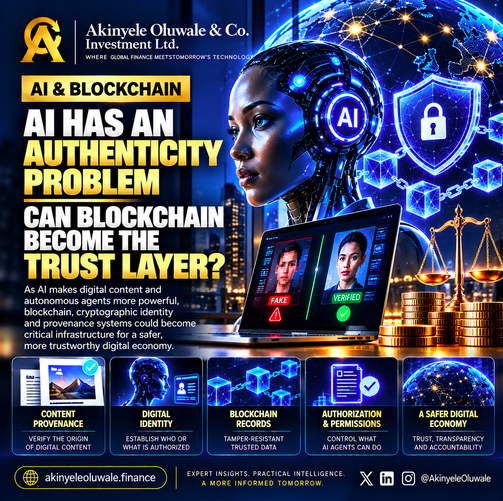
Blockchain may contribute to both. The opportunity can be understood through four layers:
IDENTITY → PROVENANCE → AUTHORIZATION → VERIFICATION
Artificial intelligence generates intelligence and content.
Cryptographic identity can establish who or what signed an action. Blockchain can provide persistent records. Verification systems can allow people and machines to inspect those records.
This does not create perfect truth but it can create something extremely valuable:
evidence.
Consider a simple example. You receive a video apparently showing the CEO of a major company announcing an acquisition.
The video looks authentic. The voice sounds authentic.
The background looks authentic. Financial markets begin reacting.
How do you determine whether it is real?
The traditional answer might be:
“Watch the video carefully.”
That approach becomes increasingly unreliable as generative AI improves.
A better question may eventually be:
Can we verify where the video originated?
Was it produced by an authorized corporate account?
Was it digitally signed? Can we establish when it was created?
Has the file been modified? Can we trace its provenance?
Those are not simply AI questions. They are questions about digital trust infrastructure.
The same issue applies to:
financial documents, research reports, photographs, news, contracts, corporate announcements, educational certificates,intellectual property, and machine-generated transactions.
As AI expands, authenticity becomes more economically valuable.
One important development is the growing attention around verifiable AI infrastructure.
The Ethereum Foundation recently highlighted the idea of provable AI, describing systems in which AI inference can be accompanied by cryptographic evidence that allows outputs or computations to be verified.
This is an important conceptual development. Normally, when an AI model gives you an answer, you trust the system that produced it but imagine a future in which certain machine operations can also provide cryptographic proof that a specified computation was executed according to agreed rules.
That could become important in high-value environments.
Think about:
financial services, healthcare administration, insurance, government systems, digital markets, autonomous agents,
and
decentralized networks.
Not every AI output requires cryptographic verification. That would be unnecessarily expensive and complicated but when machines begin controlling money, executing contracts or making economically important decisions, verification becomes much more valuable.
We should separate three concepts that are often confused.
Is the information actually correct?
Did the information genuinely come from the person or organization claiming to have produced it?
Can we trace where the information originated and what happened to it afterward?
Blockchain is not a universal truth machine.
That distinction is essential if someone records false information onto a blockchain, the blockchain does not magically transform it into truth.
What blockchain can potentially provide is a strong record showing:
who recorded something,
when it was recorded,
and
whether the record has subsequently been altered.
That is extremely useful but it is different from determining whether the original statement itself was true.
This is why serious AI-blockchain analysis must avoid exaggerated claims.
The real architecture looks more like:
AI may generate the content.
Cryptography helps establish identity.
Blockchain can preserve certain records.
Verification tools allow others to inspect them.
That is much more realistic than saying:
“Blockchain solves fake news.”
It doesn't.
But it may help us determine where information came from.
The economic implications could be substantial.
Financial markets depend heavily on information.
Company announcements. Economic data. Analyst reports. Regulatory filings. Central-bank statements. Executive interviews. News reports.
Imagine the damage that convincing AI-generated misinformation could cause if traders believe it is authentic. In such environments, verified provenance becomes valuable financial infrastructure.
AI creates another difficult question:
Who owns what?
If AI systems generate content using enormous quantities of existing information, disputes over ownership, licensing and attribution will continue.
Blockchain cannot solve every copyright dispute but verifiable records may help establish:
when digital assets were registered, who controlled them, how rights were transferred,
and
what permissions were granted.
This may be even more important. Suppose a company gives an AI agent authority to purchase cloud computing services.
The agent should not automatically have unlimited access to the company's money.
It needs boundaries.
For example:
Maximum spending: $5,000
Approved services: cloud computing
Approved suppliers: specified providers
Duration: seven days
Human approval required above: $1,000
Now the AI agent has an authorization framework.
That gives us:
This is where AI and blockchain could become extremely powerful together.
At Akinyele Oluwale & Co. Investment Ltd., our view is that one of the biggest mistakes investors can make is assuming that AI and blockchain must compete.
They solve different problems. AI primarily addresses:
intelligence.
Blockchain primarily addresses certain forms of:
coordination, ownership, settlement and verification.
AI asks:
What can the machine understand or do?
Blockchain can help answer:
Who authorized it, what happened, and can the record be verified?
Put differently:
That distinction may become increasingly important. The more autonomous AI becomes, the more accountability matters. The more digital content AI generates, the more provenance matters. The more economic activity AI performs, the more authorization matters.
The more machines transact with machines, the more auditable records matter.
Therefore, one of the most promising AI-blockchain narratives may not be another cryptocurrency.
It may be:
Watch the development of systems that allow images, videos and documents to carry verifiable information about their origins and editing history.
The key question is adoption.
A standard becomes useful when cameras, software companies, publishers and platforms support it broadly.
An autonomous agent needs an identity.
Not necessarily a human-style identity.
But other systems must know:
which agent is acting,
who controls it,
what permissions it has,
and
whether those permissions remain valid.
This could become an important digital-infrastructure market.
Cryptographic verification technologies deserve attention. Zero-knowledge systems can allow one party to prove certain information without necessarily revealing all underlying data.
Combined with AI, these technologies may eventually help verify certain computations while protecting sensitive information.
But scalability, cost and complexity remain important challenges.
Detection asks:
“Does this look fake?”
Provenance asks:
“Where did this come from?”
The second question may become increasingly important.
Detection technology faces a constant race against improving generation technology.
Provenance attempts to provide positive evidence of origin.
The future will probably require both.
Watch financial institutions, media organizations, governments and technology companies.
Consumer crypto speculation will not tell us whether blockchain-based verification is succeeding.
Enterprise adoption will.
Governments will increasingly confront difficult questions around:
AI-generated impersonation,
digital identity,
fraud,
intellectual property,
automated financial decisions,
and autonomous agents.
The interaction between regulation and technical standards could determine which trust systems scale.
Today's lesson can be summarized in eight points.
That increases productivity but also complicates authenticity.
The more convincing synthetic content becomes, the more important provenance becomes.
It can help preserve verifiable records of origin, ownership and transactions.
Machines performing economic activity need recognizable authorization.
An intelligent agent without controls creates risk.
Especially where machines perform high-value or regulated activities.
Users may interact with applications without even knowing blockchain infrastructure is operating underneath.
Our framework is:
Surrounding everything:
Akinyele Oluwale & Co. Investment Ltd. provides financial intelligence and investment education focused on global finance, institutional capital, markets and emerging technology.
Our AI & Blockchain coverage focuses on economic utility rather than technological hype.
The question we ask is not:
“Does this project mention AI?”
Nor:
“Does this project use blockchain?”
The question is:
What economic problem becomes easier to solve when these technologies are combined?
Today, that problem is increasingly clear.
Trust.
Artificial intelligence is making machines more capable but greater capability creates greater responsibility. A machine that writes an email creates limited financial risk.
A machine authorized to transfer millions of dollars creates an entirely different governance problem. An AI image generator can create entertainment.
An AI system capable of impersonating a corporate executive could potentially influence markets. An AI assistant can recommend software.
An autonomous AI procurement agent could actually purchase it. Each step toward autonomy increases the importance of:
identity, authorization, verification, auditability, and accountability.
That is where blockchain may find one of its most important long-term roles in the AI economy.
Not as a replacement for artificial intelligence. Not as a magical solution to misinformation. Not as an excuse to create another speculative token but as one component of a broader digital trust architecture.
The future internet may contain billions of interactions between humans, companies, AI agents and machines.
Those participants will need to answer basic questions:
Who are you?
Who authorized you?
What are you allowed to do?
What did you do?
Can we verify it?
The technology capable of answering those questions reliably could become extremely valuable. That is why the next phase of AI and blockchain may be less about machines becoming intelligent.
Artificial intelligence is already pushing rapidly in that direction.
The bigger challenge may be ensuring that an increasingly intelligent digital economy remains verifiable, accountable and trustworthy.
The next great digital infrastructure race may therefore be:
Observe the change. Understand the implications. Position with discipline.
Akinyele Oluwale & Co. Investment Ltd.
Where Global Finance Meets Tomorrow's Technology.
akinyeleoluwale.finance
This publication is for educational and informational purposes and does not constitute individualized investment, financial, legal or tax advice.