







Published: October 26, 2026 | Category: Institutional Finance | By: Akinyele Oluwale
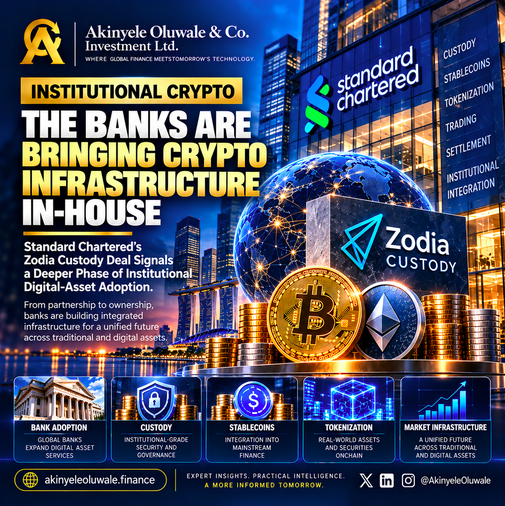
The institutional crypto market is undergoing an important structural transition. Large financial institutions are increasingly moving beyond providing clients with simple exposure to Bitcoin and Ether.
They are building or acquiring the infrastructure required to service digital assets. Standard Chartered's Zodia transaction is a powerful example.
The bank says Zodia's regulated custody operations across Singapore, Hong Kong, Australia, the United Arab Emirates and Luxembourg will ultimately be integrated with its existing digital-asset custody activities.
Its stated objective is particularly revealing:
to build a unified institutional offering combining traditional and digital-asset securities services.
That is the real story. The institutional digital-asset market is moving from:
“How can clients access crypto?”
toward:
“How can digital assets become part of normal institutional financial operations?”
Those are fundamentally different questions. The first is about investment access. The second is about infrastructure and infrastructure is where institutional adoption becomes durable.
Imagine a large pension fund, asset manager, hedge fund or corporation considering digital assets. Buying the asset is only the beginning. The institution must also answer:
Who holds the asset? How are private keys protected? Who has authority to move it? How are transactions approved?
How is ownership recorded? How does the institution satisfy regulators? How are assets separated from those belonging to other clients? How are transactions reconciled?
How does digital-asset custody interact with the institution's existing portfolio systems?
How are risks monitored? These questions explain why custody is so important. For an individual, custody can mean protecting a wallet. For a financial institution, custody is an entire operating system of:
SECURITY → GOVERNANCE → AUTHORIZATION → RECORDKEEPING → COMPLIANCE → REPORTING → SETTLEMENT
Institutional investors cannot simply behave like individual cryptocurrency users.
They operate under mandates, internal controls, regulatory obligations and fiduciary responsibilities.
That creates demand for infrastructure capable of bringing digital assets into familiar institutional frameworks.
Standard Chartered's strategy should be understood in that context.
On October 21, Standard Chartered announced that it had signed definitive agreements to acquire Zodia Custody. The development followed acceptance in May of the bank's earlier non-binding acquisition offer. The transaction remains subject to regulatory approvals and customary closing conditions.
Upon completion, Standard Chartered plans to integrate Zodia's regulated custody operation into its existing digital-asset custody activities within Securities Services.
Zodia's software and professional-services activities will take a different route. Those assets are expected to move into a separate entity called Zodia Solutions, established under SC Ventures.
This creates an interesting structure.
One side becomes:
BANK-OWNED REGULATED CUSTODY
The other remains:
DIGITAL-ASSET INFRASTRUCTURE TECHNOLOGY
That separation is strategically important. It recognizes that custody and technology infrastructure perform different roles. The custodian safeguards assets and operates within regulated financial structures.
The technology provider supplies the systems institutions need to develop and scale digital-asset capabilities.
Institutional crypto is becoming specialized and specialization is often a sign of market maturation.
The acquisition should not be viewed in isolation. Standard Chartered has been steadily assembling different pieces of an institutional digital-asset ecosystem. Earlier this month, the bank announced plans to extend custody services in Singapore for selected cryptoassets, stablecoins and tokenized real-world assets, subject to regulatory requirements.
Its custody footprint already extends across important international financial centres. The bank has also launched institutional support for Ripple's RLUSD stablecoin through its DIFC branch in Dubai.
Separately, it has been working toward connecting RLUSD with institutional collateral infrastructure and it has introduced cryptocurrency trading for eligible affluent clients in the UAE through an integrated banking model.
Taken together, these developments reveal something much larger than a collection of crypto announcements. They show the construction of an ecosystem.
Think about the progression:
CUSTODY
↓
TRADING
↓
LIQUIDITY
↓
COLLATERAL
↓
STABLECOINS
↓
TOKENIZED ASSETS
↓
SETTLEMENT
↓
INSTITUTIONAL SECURITIES SERVICES
That begins to resemble a digital version of traditional capital-market infrastructure and that is precisely why this development matters.
Investors should resist the temptation to interpret this transaction as a short-term Bitcoin price signal. It is not.
Standard Chartered acquiring digital-asset custody infrastructure does not mean Bitcoin must rise tomorrow. The significance is structural.
A bank investing capital, management attention and regulatory resources into digital-asset infrastructure is making a different kind of decision from an investor purchasing cryptocurrency.
One is an asset-allocation decision. The other is an infrastructure investment decision. Infrastructure decisions are generally based on longer-term expectations about client demand and future financial activity.
That distinction gives us an important framework:
All three matter but they tell us different things.
Bitcoin's price can fall while institutional infrastructure improves.
ETF outflows can occur while banks expand custody.
Crypto-market sentiment can weaken while tokenization infrastructure advances. This is why institutional crypto should never be analysed solely through price charts.
At Akinyele Oluwale & Co. Investment Ltd., we believe the Zodia development illustrates one of the most important transitions occurring in digital finance:
Institutional crypto is moving from partnership dependency toward infrastructure ownership.
That is a major distinction.
During the early stages of financial innovation, established institutions frequently rely on specialist technology companies.
This allows them to experiment without rebuilding their entire operating infrastructure but as an activity becomes strategically important, institutions may decide that critical capabilities should sit closer to the core business.
That appears to be what we should watch now.
The strategic progression can be expressed as:
Not every bank will follow this route. Some may continue partnering with specialist custodians. Others may build internally.
Some may acquire. There is no single correct architecture but the strategic question is changing. Banks are increasingly asking:
Which parts of the digital-asset value chain do we need to control ourselves?
Custody is an obvious candidate.
Why?
Because custody sits at the centre of trust If an institution cannot safeguard the asset, everything else becomes secondary.
The acquisition is not yet completed.
It remains subject to regulatory approvals and closing conditions.
That qualification is essential.
A definitive agreement is considerably more advanced than a proposal, but it is not the same as a completed transaction.
This may be the most important indicator.
Watch whether digital assets become increasingly embedded alongside traditional securities services rather than remaining a separate crypto division.
If that happens, the distinction between “traditional assets” and “digital assets” may gradually become less important operationally.
Standard Chartered plans to expand digital-asset custody in Singapore.
The proposed offering includes selected cryptoassets, stablecoins and tokenized real-world assets.
That combination is important.
It suggests custody is moving beyond Bitcoin and Ether toward a broader digital-asset universe.
The bank's RLUSD custody initiative deserves attention.
Institutional markets require efficient collateral.
If regulated stablecoins increasingly become usable within institutional trading and collateral systems, they could develop an economic role far beyond crypto exchange settlement.
This may be the biggest strategic question.
Will competitors respond by:
building internally,
partnering,
or
acquiring specialist digital-asset infrastructure?
If acquisitions increase, institutional crypto could enter a consolidation phase.
That would represent another important stage of maturation.
The eventual objective may not be separate systems for crypto and traditional finance.
It may be a unified institutional platform capable of servicing:
Bitcoin
Ether
Stablecoins
Tokenized deposits
Tokenized bonds
Tokenized funds
Traditional securities
and potentially other real-world assets.
That is a much bigger opportunity than cryptocurrency custody alone.
The Standard Chartered–Zodia transaction provides seven important lessons.
The story is moving beyond asset prices toward the systems supporting digital finance.
Partnerships are increasingly being complemented by direct ownership and internal integration.
Institutional capital requires security, governance, compliance and operational controls.
This may eventually matter more than maintaining standalone “crypto divisions.”
Their potential role increasingly includes settlement, collateral and payments.
Institutional custody may ultimately cover much more than cryptocurrencies.
The institutional framework is increasingly:
Surrounding the entire architecture:
Akinyele Oluwale & Co. Investment Ltd. provides financial intelligence and investment education focused on global finance, institutional capital, markets and emerging technology.
Our Institutional Crypto coverage is built around a simple principle:
Follow the infrastructure, not only the price.
Cryptocurrency prices can change dramatically within hours. Infrastructure evolves much more slowly but infrastructure can ultimately determine which financial technologies survive.
That is why developments such as Standard Chartered's Zodia transaction deserve attention. The significance is not that another bank has suddenly “become bullish on crypto.”
That would oversimplify the story.
The deeper significance is that a major international financial institution sees enough potential institutional demand to continue investing in the systems required to safeguard and service digital assets.
The distinction matters.
Institutional adoption should increasingly be measured through questions such as:
Are banks offering custody?
Are institutional trading systems developing?
Can digital assets function as collateral?
Can stablecoins integrate with regulated finance?
Can tokenized assets operate inside institutional portfolios?
Can digital securities interact with traditional settlement infrastructure?
Can institutions manage digital assets under the same governance standards applied to conventional securities and increasingly:
Are financial institutions willing to own the infrastructure themselves?
That final question may define the next stage.
The first institutional crypto era was about access.
The second was about infrastructure.
The next may increasingly be about ownership, integration and scale.
Standard Chartered's proposed acquisition of Zodia Custody gives us a clear example of that transition.
Crypto infrastructure is no longer necessarily something sitting outside the banking system. Parts of it are gradually moving inside and when infrastructure moves inside institutions, digital assets move one step closer to becoming part of ordinary financial architecture.
That does not guarantee universal adoption.
It does not eliminate regulatory risk.
It does not guarantee that every digital asset will survive and it certainly does not mean price speculation should replace disciplined analysis.
It means something more important:
the institutional digital-asset market is becoming structurally deeper.
The future may therefore be less about:
Traditional Finance versus Crypto
and increasingly about:
The institutions capable of combining both worlds securely, efficiently and within credible regulatory frameworks may ultimately shape the next architecture of global finance.
Observe the change. Understand the implications. Position with discipline.
Akinyele Oluwale & Co. Investment Ltd.
Where Global Finance Meets Tomorrow's Technology.
akinyeleoluwale.finance
This publication is for educational and informational purposes and does not constitute individualized investment, financial, legal or tax advice.

Published: October 26, 2026 | Category: Institutional Finance | By: Akinyele Oluwale
Related Categories: Crypto & Digital Assets • Tokenization & RWAs • Stablecoins & Payments • Blockchain & Technology
The latest developments suggest that institutional digital assets are progressing from an era dominated by cryptocurrency exposure toward something much broader:
financial-market infrastructure.
The emerging institutional architecture now includes:
CRYPTO ASSETS → CUSTODY → STABLECOINS → TOKENIZED SECURITIES → ONCHAIN TRADING → DIGITAL SETTLEMENT → FINANCIAL INTEGRATION
This transition is significant but it introduces new challenges. When Bitcoin is purchased through an ETF, the primary questions concern investment exposure, liquidity and custody. When a company's shares are tokenized and potentially traded on blockchain infrastructure, the questions become considerably more complex.
Who controls the authoritative shareholder record? Are investors receiving the same legal rights? How is liquidity maintained?
Who provides market surveillance? How are dividends and voting rights handled? Can an issuer refuse tokenization?
What happens when trading becomes available outside traditional market hours? How does blockchain settlement interact with established securities infrastructure?
Those are no longer purely crypto questions. They are capital-market architecture questions.
That is why the latest developments matter.
There is an important difference between:
putting an asset on a blockchain
and
building a functioning institutional market around that asset.
Technology can make tokenization possible but technology alone cannot create institutional trust. For financial markets to operate at scale, participants need more than software.
They need:
Legal certainty
Custody
Liquidity
Price discovery
Investor protection
Governance
Operational resilience
Regulatory supervision
Clear ownership rights
This produces one of the most important principles in institutional digital finance:
Tokenization can change how an asset moves. It does not automatically change what the asset legally represents.
A token representing a share must ultimately connect to enforceable economic and legal rights. Without that connection, technological innovation can create complexity rather than efficiency.
Institutional adoption therefore depends on bringing two worlds together:
DIGITAL INFRASTRUCTURE + LEGAL FINANCIAL INFRASTRUCTURE
Neither can succeed at institutional scale without the other.
On October 21, the OCC announced a final rule implementing the GENIUS Act.
The development matters because payment stablecoins are increasingly being discussed not simply as crypto-market instruments, but as potential components of mainstream payments and digital financial infrastructure. For institutional finance, regulatory clarity can change the conversation.
Banks and financial companies generally cannot build major financial products simply because the technology is attractive.
They require clarity around:
Compliance
Reserves
Supervision
Risk management
Custody
Operational responsibilities
Regulation therefore functions as infrastructure. The institutional stablecoin equation increasingly looks like:
REGULATION → TRUST → INSTITUTIONAL PARTICIPATION → DISTRIBUTION → LIQUIDITY → ADOPTION
But regulation does not guarantee success. It creates the framework within which competition and adoption can occur.
That distinction is important.
The second development may ultimately be even more instructive.
The SEC's Innovation Exemption created a temporary conditional pathway for certain Tokenized Securities Venues to facilitate blockchain-based trading of tokenized U.S. listed stocks.
The SEC subsequently published implementation guidance and began listing entities that had submitted notices indicating an intention to operate under the exemption.
That sounds like straightforward progress toward onchain capital markets but implementation is revealing the complexity.
Reuters reported on October 23 that Wells Fargo, Arm Holdings and Intuit were among six additional companies objecting to tokenization of their shares on the proposed OKX-ICE platform.
The total number of companies reported as objecting reached 22, including Microsoft and Alphabet.
That does not mean tokenization has failed. It means tokenization has reached the stage where governance matters.
And that is progress of a different kind.
Institutional crypto is gradually becoming less about cryptocurrency alone. Consider what is developing across global finance.
Deutsche Bank is preparing to introduce institutional digital-asset custody in Germany, with plans for a broader Asian expansion. Its strategy extends beyond Bitcoin and Ether.
The bank has also discussed stablecoins, tokenized deposits and blockchain-based securities such as digital bonds.
Standard Chartered has already launched institutional spot Bitcoin and Ether trading in the UAE, becoming the first global systemically important bank to provide the service there.
Meanwhile, the SEC is creating a pathway for experimentation with tokenized traditional securities and the OCC is implementing a federal regulatory structure for payment stablecoins.
Put these developments together. The architecture begins to look very different from the crypto market of five years ago.
It becomes:
BANKS + ASSET MANAGERS + BLOCKCHAIN + STABLECOINS + TOKENIZED SECURITIES + REGULATED CUSTODY + DIGITAL SETTLEMENT
That is not simply cryptocurrency adoption. It is potential financial infrastructure convergence.
The immediate temptation is to ask:
What does this mean for Bitcoin's price?
That is not the most useful question.
Bitcoin remains an important part of institutional digital-asset adoption but the institutional crypto story is becoming wider than Bitcoin.
There are now several separate layers.
Bitcoin and Ether investment products allow institutions to gain market exposure without necessarily rebuilding their entire operational infrastructure.
Banks and specialist custodians provide mechanisms for holding digital assets within institutional governance structures.
Institutional trading infrastructure connects buyers, sellers, liquidity providers and financial intermediaries.
Stablecoins and tokenized deposits could provide mechanisms for transferring value across blockchain-based systems.
Stocks, bonds, funds and real-world assets can potentially be digitally represented on blockchain infrastructure.
Blockchain could potentially reduce some of the friction between trading and final settlement.
The institutional opportunity therefore extends far beyond speculation but so do the risks.
At Akinyele Oluwale & Co. Investment Ltd., we believe the latest developments reveal an important truth:
Institutional crypto is becoming institutional finance.
That does not mean traditional finance is disappearing.
Quite the opposite.
Traditional financial institutions are increasingly determining how digital assets become integrated into mainstream finance.
The emerging model may therefore be less:
CRYPTO vs WALL STREET
and increasingly:
WALL STREET + DIGITAL-ASSET INFRASTRUCTURE
But integration changes the rules of the game. A decentralized technology entering regulated capital markets must interact with:
Property rights
Securities law
Corporate governance
Investor protection
Custody rules
Market surveillance
Capital requirements
Operational risk
This is why issuer objections to tokenized shares should not automatically be interpreted as opposition to blockchain. They reveal something more fundamental.
Financial assets are bundles of legal rights not merely digital objects.
Technology can improve the infrastructure carrying those rights. It cannot simply ignore them. That is the institutional reality test.
Several developments now deserve close attention.
The SEC currently lists entities that have submitted notices regarding operation under its Tokenized Securities Venue exemption but submitting a notice and building a successful institutional market are very different achievements.
Watch for:
Live trading
Institutional participation
Liquidity
Volumes
Issuer participation
Settlement performance
This may become one of the most important indicators. If significant numbers of public companies resist third-party tokenization, platforms may need to rethink how issuer consent and corporate governance are incorporated.
The OCC's final GENIUS Act rule moves the regulatory architecture forward.
The next question is commercial.
Which institutions actually build?
Which products attract users?
Which payment networks integrate stablecoins?
And where does genuine transaction volume develop?
The planned German launch deserves close attention.
The important question is not simply whether Deutsche Bank can custody Bitcoin.
The strategic significance lies in the potential progression:
CRYPTO CUSTODY → STABLECOINS → TOKENIZED DEPOSITS → DIGITAL SECURITIES
That begins to resemble a complete institutional digital-asset stack.
If different banks, exchanges and blockchain networks build separate systems, fragmentation could become a major problem.
Institutional markets require assets and money to move efficiently across infrastructure.
The eventual winners may therefore be systems capable of connecting:
Traditional markets
Public blockchains
Permissioned networks
Banking infrastructure
Tokenized assets
Digital money
Interoperability may ultimately matter as much as tokenization itself.
This week's developments leave institutional investors with seven important lessons.
The discussion is increasingly about implementation.
The OCC's stablecoin rule demonstrates that digital money is moving deeper into formal financial architecture.
Issuer objections demonstrate that technological possibility does not automatically produce institutional acceptance.
Custody is increasingly being connected to trading, stablecoins, tokenized deposits and digital securities.
Putting a financial asset onchain does not eliminate securities law, shareholder rights or corporate governance.
Institutional adoption requires security, liquidity, governance, compliance and operational resilience.
The institutional crypto architecture increasingly looks like:
And surrounding the entire system:
Akinyele Oluwale & Co. Investment Ltd. provides financial intelligence and investment education focused on global finance, institutional capital, markets and emerging technology.
Our Institutional Crypto series deliberately looks beyond daily cryptocurrency prices.
Price matters. Capital flows matter but neither tells the entire story.
The deeper transformation is happening in the infrastructure.
Banks are entering custody. Traditional financial institutions are providing crypto trading. Stablecoins are entering clearer regulatory frameworks. Tokenized deposits are being explored.
Traditional securities are moving toward blockchain experimentation. Regulators are building frameworks around those developments and corporations are beginning to assert their own interests as tokenization moves closer to real capital markets.
This is precisely what a maturing technology looks like.
The conversation becomes more difficult. The stakeholders multiply. The regulatory questions become more sophisticated.
Governance becomes unavoidable and technological innovation must demonstrate economic value.
The next stage of institutional crypto will therefore not be won simply by the blockchain with the highest transaction speed or the cryptocurrency generating the most attention.
The more important questions will be:
Can the infrastructure be trusted?
Can institutions operate within it safely?
Are ownership rights legally enforceable?
Is there sufficient liquidity?
Can regulators supervise it?
Do issuers participate willingly?
Does it reduce cost or improve efficiency?
Can it integrate with the financial system already handling trillions of dollars of capital?
Those questions represent the difference between technological experimentation and institutional adoption.
Institutional crypto has reached that boundary. The experiment is becoming infrastructure and infrastructure must now pass the reality test.
Observe the change. Understand the implications. Position with discipline.
Akinyele Oluwale & Co. Investment Ltd.
Where Global Finance Meets Tomorrow's Technology.
akinyeleoluwale.finance
This publication is for educational and informational purposes and does not constitute individualized investment, financial, legal or tax advice.
Published: October 25, 2026 | Category: AI | By: Akinyele Oluwale
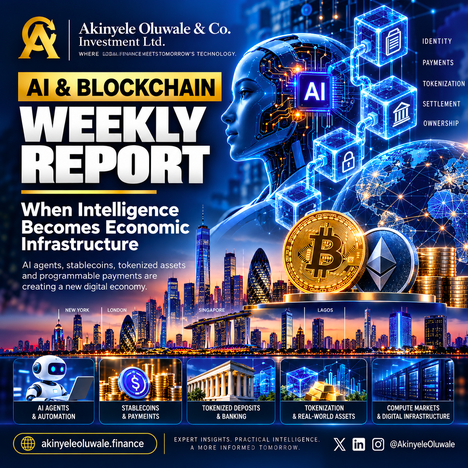
For years, artificial intelligence and blockchain were largely discussed as separate technological revolutions. Artificial intelligence was about intelligence:
Data → Models → Reasoning → Automation → Productivity
Blockchain was about digital ownership and transactions:
Assets → Identity → Payments → Verification → Settlement
Those two worlds are now beginning to intersect.
The reason is surprisingly simple.
As artificial intelligence becomes more autonomous, AI systems increasingly need capabilities beyond generating text, images or computer code.
They may need to purchase data.
They may need to acquire computing capacity.
They may need to pay for digital services.
They may need to verify identity.
They may need to interact with financial assets and eventually, some AI agents may need to execute economic transactions with limited human intervention.
That creates a fundamental question:
What financial infrastructure will machines use when machines themselves become economic participants?
This week's developments suggest that blockchain technology, stablecoins, tokenized deposits and programmable payments could become part of the answer.
The emerging architecture is:
AI INTELLIGENCE → DIGITAL IDENTITY → PROGRAMMABLE PAYMENTS → BLOCKCHAIN SETTLEMENT → TOKENIZED ASSETS → MACHINE ECONOMY
This does not mean every AI system needs a blockchain.
It does not mean every blockchain needs AI and it certainly does not mean every token labelled “AI” represents a serious investment opportunity.
The more important development is deeper.
We may be witnessing the early construction of financial infrastructure designed not only for humans and corporations—but increasingly for software itself.
The convergence between artificial intelligence and blockchain is moving from narrative toward experimentation and early real-world infrastructure. One of the most significant developments is the rise of AI agents.
Traditional AI responds to instructions.
AI agents are being developed to perform tasks, make decisions, interact with software and coordinate activities with greater autonomy. Once those agents begin performing economic tasks, they require economic infrastructure.
That is where blockchain and digital assets become particularly interesting.
Recent developments point toward five emerging areas:
Autonomous software is beginning to use programmable payment infrastructure to purchase services and data.
Stablecoins could provide always-available digital money capable of moving between software systems.
Banks are experimenting with blockchain-based representations of commercial-bank money.
Autonomous agents will need ways to establish identity, permissions and transaction history.
Computing power itself could eventually become a digitally represented economic resource.
The broader architecture could therefore become:
INTELLIGENCE → IDENTITY → COMPUTE → PAYMENTS → SETTLEMENT → OWNERSHIP → VERIFICATION
But investors and businesses should remain disciplined.
Many applications remain experimental.
The long-term winners will probably not be determined by which projects use the most fashionable terminology.
They will be determined by real economic utility.
The first generation of generative AI largely helped humans produce information.
Write an email.
Generate an image.
Analyse a spreadsheet.
Summarise a document.
Write computer code.
The emerging generation of AI agents potentially goes further.
An agent could receive an objective and interact with different systems to accomplish it. Imagine a future corporate AI agent instructed to:
Find computing capacity → compare providers → purchase capacity → run a workload → verify completion → settle payment → record the transaction.
That requires more than intelligence.
It requires financial infrastructure.
Traditional payment systems were largely designed around people and organisations.
Accounts are opened by humans.
Payments are authorised through established banking relationships.
Transactions frequently depend upon identity systems, financial intermediaries and operating hours designed around human institutions.
Machines create a different challenge.
Software can operate:
24 hours a day
7 days a week
across borders
at high frequency and potentially execute enormous numbers of very small transactions.
This is where programmable digital money becomes interesting.
Blockchain infrastructure can potentially provide software with mechanisms for transferring value and recording transactions programmatically.
Stablecoins can potentially provide the payment instrument.
Tokenized assets could potentially provide digitally accessible ownership.
AI provides the intelligence.
The combination could create an entirely new category of economic infrastructure.
Several developments surrounding the AI-blockchain intersection deserve attention.
One of the clearest signals comes from agentic payments.
Recent Chainalysis-linked reporting indicates that more than 138 million transactions have been recorded through Coinbase's x402 protocol on the Base blockchain. The important point is not simply the number. It is what the transactions represent.
Software agents can use programmable payment infrastructure to purchase data, access services and interact economically with other systems.
This represents a significant conceptual shift. The internet originally connected information. Digital commerce connected people and businesses. AI agents could eventually create another layer:
machine-to-machine commerce.
Another important development comes from traditional banking.
HSBC and Ant Digital recently tested a system in which AI agents could discover digital services and make micropayments using HSBC's tokenized deposits. The demonstration combined tokenized bank deposits, AI-agent infrastructure and blockchain-based settlement.
The AI agent selected a service and completed a payment while the system performed settlement and risk checks but an important qualification must be made.
This was a technical trial.
It was not announced as a commercial customer service. That distinction matters because serious financial analysis must separate:
Prototype → Pilot → Commercial Deployment → Adoption → Scale
Nevertheless, the experiment is significant because it shows how established banking infrastructure could eventually interact with autonomous software.
The larger story is not really “AI plus crypto.” That description is too narrow. The bigger story is the emergence of what could become a machine-native economy.
BlackRock recently described AI and digital assets as sharing a machine-native foundation. Its analysis highlights an important distinction.
Artificial intelligence increasingly converts information into standardized digital representations that machines can process.
Blockchain technology can digitally represent economic value and ownership rights in forms that machines can potentially verify and transfer.
That produces an interesting combination:
AI processes information.
Blockchain can represent and transfer value.
Put differently:
AI may become an intelligence layer while blockchain becomes part of the economic coordination layer.
BlackRock also identifies machine-to-machine payments and computing resources as areas where digital assets could become increasingly relevant as AI agents become more capable.
This deserves attention because computing capacity is becoming an increasingly strategic economic resource.
Modern AI requires enormous quantities of:
GPUs
Data centres
Electricity
Cloud infrastructure
Networking capacity
Training data
If access to computing resources becomes increasingly standardized and programmable, digital markets for compute could eventually become more important.
The investment implications need careful interpretation. The existence of an AI-blockchain trend does not mean every so-called AI token will benefit. That would be a dangerous analytical shortcut.
Instead, investors should separate the technology stack.
AI requires enormous computing resources. Distributed-compute networks are experimenting with alternative ways of coordinating computing capacity.
The economic question is:
Can decentralized compute compete effectively on price, reliability, availability and performance?
AI depends on data.
Blockchain systems may potentially help with provenance, permissions and economic incentives surrounding data but blockchain cannot automatically guarantee that information is truthful.
It can help establish that a particular record existed, who submitted it or whether it was altered.
That distinction is essential.
Autonomous agents will need identity.
If millions of AI agents eventually interact economically, systems will need to determine:
Who controls the agent?
What is it permitted to do?
What resources can it access?
How much can it spend?
Who is responsible when something goes wrong?
This could become one of the most important areas of AI governance.
This may be the clearest blockchain opportunity. AI agents need programmable money. Stablecoins and tokenized bank deposits are two possible solutions.
The HSBC experiment demonstrates why financial institutions are exploring the concept.
Blockchain networks can potentially provide infrastructure for digitally representing and transferring ownership.
This becomes increasingly relevant as financial assets themselves become tokenized.
The future could therefore connect:
AI Agents + Digital Identity + Stablecoins + Tokenized Deposits + Tokenized Assets + Blockchain Settlement
That is potentially much more important than simply creating another “AI coin.”
At Akinyele Oluwale & Co. Investment Ltd., we believe the AI-blockchain conversation should move beyond speculation. The serious question is not:
Which AI token will rise next?
The better question is:
What economic problem is being solved?
That produces a much stronger analytical framework.
Ask seven questions:
What is the problem?
Why is AI necessary?
Why is blockchain necessary?
Who pays for the service?
Where does the revenue come from?
Does the technology improve cost, speed, security or efficiency?
Can the system scale?
If those questions cannot be answered clearly, investors should be cautious.
Adding “AI” to a blockchain project does not create economic value.
Adding a token to an AI application does not automatically create token value and putting data on a blockchain does not automatically make that data trustworthy.
Real adoption requires:
UTILITY → USERS → TRANSACTIONS → REVENUE → INFRASTRUCTURE → SCALE
This is where hype must meet economics.
Several indicators deserve close attention.
Are machine-to-machine payments continuing to grow? More importantly, are those transactions connected to genuine economic services rather than incentives or experimentation?
Stablecoins could become important infrastructure for autonomous commerce.
Watch whether AI platforms increasingly integrate programmable stablecoin payments.
The HSBC experiment is particularly interesting because it demonstrates that the future does not necessarily have to be:
Banks versus blockchain.
It could become:
Banks using blockchain infrastructure.
Tokenized deposits could allow traditional banking money to interact with programmable financial systems.
Autonomous economic activity requires accountability.
Identity, authorization and governance could therefore become major infrastructure layers for AI agents.
AI computing capacity is becoming economically strategic.
Watch whether tokenized or decentralized compute markets can develop genuine demand beyond crypto-native users.
Regulators are paying attention.
The U.S. Securities and Exchange Commission announced that AI and risks connected to tokenized securities will feature among its fiscal-2027 examination priorities.
That tells us something important:
AI and tokenization are no longer being treated solely as technology experiments.
They are increasingly becoming matters of financial supervision, compliance and investor protection.
This week's developments leave us with seven important conclusions.
The emergence of AI agents changes the conversation.
Machines that purchase services need mechanisms for identity, authorization, payment and settlement.
Their programmability and digital-native structure make them relevant to autonomous commerce.
Tokenized deposits demonstrate that blockchain-based machine payments do not necessarily require abandoning traditional banking.
AI's enormous demand for processing power creates opportunities for new markets around computing resources.
The words “AI,” “blockchain” and “token” do not constitute a business model.
The projects and infrastructure that survive will need to demonstrate genuine economic value.
Our framework is therefore:
Surrounding everything:
Akinyele Oluwale & Co. Investment Ltd. provides financial intelligence and investment education focused on the intersection of global finance, institutional capital, markets and emerging technology.
Our approach to AI and blockchain is deliberately different from the speculative narratives that frequently dominate technology markets.
We are interested in infrastructure.
We are interested in economic utility.
We are interested in productivity.
We are interested in capital and we are interested in understanding which technologies could genuinely reshape the architecture of global finance.
The convergence between artificial intelligence and blockchain is still developing.
Many experiments will fail.
Some ideas will never achieve commercial scale.
Others may evolve into important infrastructure.
The task for investors, businesses and policymakers is therefore not to accept every technological prediction. It is to identify where genuine economic value is emerging.
AI can provide intelligence.
Blockchain can provide programmable economic infrastructure.
Stablecoins and tokenized deposits can provide digital payment instruments.
Tokenization can transform ownership rights into machine-readable financial assets.
Digital identity can establish permissions and accountability.
Together, these technologies could potentially create something fundamentally different:
an economy in which software can increasingly participate in economic activity alongside humans and institutions.
That possibility deserves serious attention but it also demands serious governance.
The future of AI and blockchain will not be determined by technology alone. It will be determined by whether these technologies can combine to create systems that are:
Useful.
Secure.
Trusted.
Economically sustainable.
Regulated appropriately.
Capable of operating at scale.
The biggest AI-blockchain opportunity may therefore not be another cryptocurrency.
It may be the infrastructure that allows intelligent machines to interact safely with economic value. That is the development worth watching.
Observe the change. Understand the implications. Position with discipline.
Akinyele Oluwale & Co. Investment Ltd.
Where Global Finance Meets Tomorrow's Technology.
akinyeleoluwale.finance
This publication is for educational and informational purposes and does not constitute individualized investment, financial, legal or tax advice.